#58 Chemicals for ceramic glazes: the milling stage



Starting point: The application of glazes along the glazing line is one of the most delicate stages in ceramic production. To achieve high performance, the glaze must display well-defined rheological properties, capable of adapting to the specific — and constantly changing — conditions of the production line.
In short: A well-formulated glaze suspension is the essential prerequisite for proper application and for a result that is both technically sound and aesthetically consistent.
Imagine a paradoxical situation: what if a glaze were milled using nothing but water, with no additives at all?
The outcome could vary, but a few issues would inevitably arise:
- Poor cohesion, potentially leading to surface dusting
- Rapid settling of the solid particles in suspension
- Failure to level properly on the ceramic surface
These are just the headline problems. We don’t need to explore every possible drawback to see the point: a glaze without additives simply doesn’t work. It cannot deliver reliable, high-quality performance. So why is that the case?
Because a glaze suspension is essentially a mixture of inorganic raw materials and frits milled in water. In this raw form, it does not naturally exhibit the properties required to remain stable, cohesive, and properly leveled at application density.
How glaze behaves in practice
Here’s a practical example.
Take the use of traditional airless systems in a spray booth: when everything is working properly, the glaze is atomized onto the ceramic surface, it spreads smoothly, and it dries to an even layer. Three steps that look straightforward but rely on more than the glaze itself.
This performance is only possible thanks to carefully balanced chemical additives, both organic and inorganic. Without them, the glaze would settle in the circuit, spray unevenly, and coat the surface poorly leading to drips and patchy coverage.
On top of that, drying must happen within a precise window of time to avoid repellency issues, especially when water-based glazes interact with solvent-based inks.

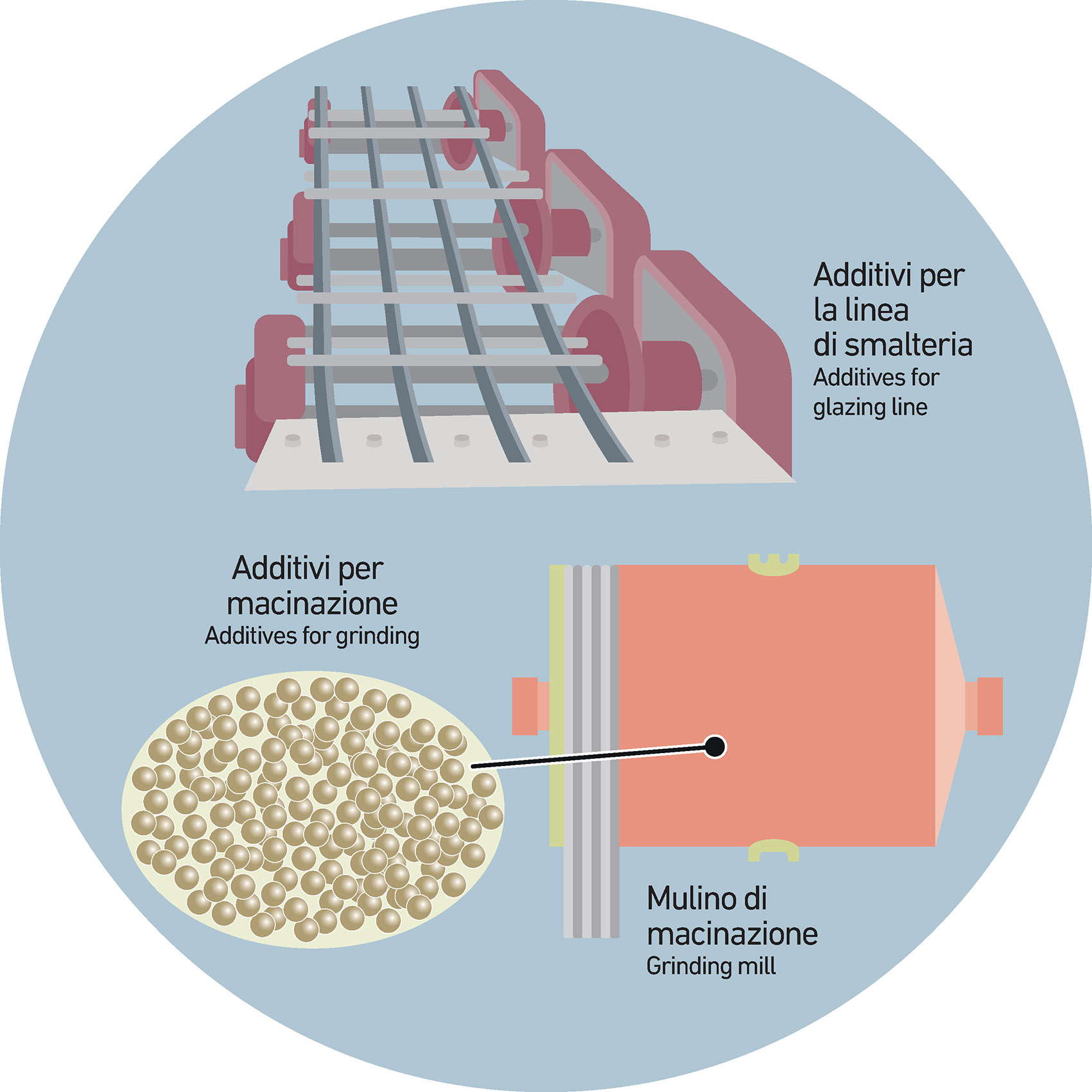
Chemical additives for glazes can be introduced at two key points in the process:
- During the milling stage
- Directly on the glazing line, at the application stage
Chemicals for milling: deflocculants and binders
Even at this early stage, it is essential to carry out a preliminary assessment and select the right combination of deflocculants and binders. The choice depends on the type of glaze, the intended application method, and the specific parameters of the production line.
Let’s look at two different scenarios.
Milling for airless applications
A high-density airless application — characterized by low water content and a high proportion of solids — typically requires deflocculants with a strong viscosity-reducing effect, capable of significantly lowering the suspension’s viscosity. If the viscosity is too high, problems can arise during application, affecting both the equipment and the glaze layer on the ceramic body.
At the same time, specific binders are also necessary to ensure cohesion of the glaze. Without them, the glaze may not adhere properly to the substrate and can show leveling defects.
By contrast, in low-density airless applications — such as those used for top glaze layers — deflocculants should be less aggressive or used in smaller amounts. Excessive fluidification could destabilize the system and promote sedimentation.
Milling for bell or waterfall applications
When it comes to bell or curtain coating systems, the approach is quite different. In this case, the glaze relies on high-grade rheological or cohesive additives with a very low ionic content, which helps prevent firing defects such as pin holing or bubbling.
Unlike airless spraying, this method calls for a glaze that is denser and more strongly bound. Since the glaze isn’t atomized but flows onto the surface by gravity, it needs to hold its body and viscosity to ensure a smooth, compact layer throughout application.
Final considerations
When it comes to milling additives, even a few examples are enough to show that there is no such thing as a universal standard. Application contexts vary widely, and the technical variables are too numerous for a one-size-fits-all formula.
What is clear, however, is this: the right additive strategy during milling not only enhances performance during application but also makes the milling process itself more efficient.
Take milling times, for instance. A glaze with good internal cohesion is easier to process, reducing the time needed to achieve the desired particle size — and ultimately improving overall industrial productivity.