#18 What benefits can you get by using water-based digital glues?



- Glues’ chemical nature and main features
- Reduction of polluting emissions:
- What happens inside the kiln
- The reason of the decrease in emissions
- Reduction of odor emissions
- Technical & aesthetic features:
- Drainage times
- Leveling power
- Improved printing definition
- Improved management of the amount of grit
1. Glues chemical nature and features
In ceramic, the water-based digital system is a very important topic of interest. The R&D departments of all players have been doing research for some time, trying to improve the sector with a technology that is already in use in many other fields of the industrial production.
Technical problems of both application machines and products (such as inks and glues) seem to be over, and the time is ripe for a final spread of this technology that surely offers several benefits: technical, aesthetical, and environmental.
MAIN GLUE’S COMPONENTS
Chemically speaking, water-based digital glues can be generally considered as organic polymers and inorganic components (when present) in water and polar solvents. Their chemical nature, unlike that of solvent-based digital glues, is firstly marked by the elimination of those non-polar components that help to spread pollutants and bad odors in atmosphere.
Their composition generally consists of:
- 35% – water
- 45/55% – polar solvents and resins
- 10/20% – inorganic components
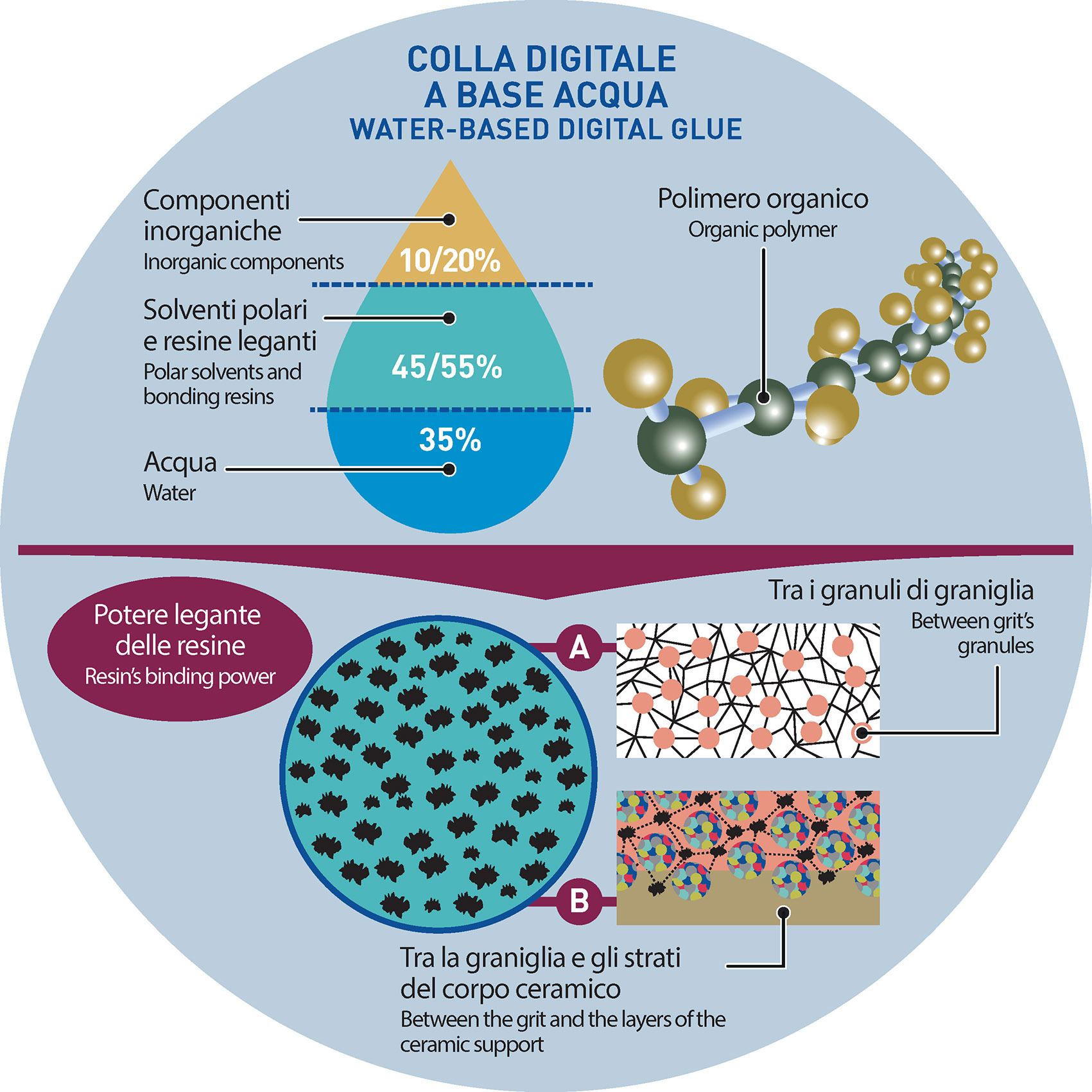
Among those elements, resins are mainly responsible for the binding power required to fix the grit.
They develop their action not only between the granules of the grit but also between the grit and the layers of the tile; the action takes place after the solvent has been evaporated and partially absorbed by the ceramic support due to tile’s high temperature. Following here, the most significant benefits promoted by water-based digital glues.
2. Reduction of polluting emissions
The problem of atmospheric emissions is one of the most important issues that concerns environmental impact and that has been for some time under the attention of lawmakers, industries, and institutional analysis. In this regard, the most important parameters that must be constantly checked by ceramic industries are:
- Particulate matter
- Fluorine
- Volative Organic Compounds
- Aldehydes and Formaldehyde
- Organic acids
- Lead
- Nitric oxide
- Sulphur dioxide
- Chlorine
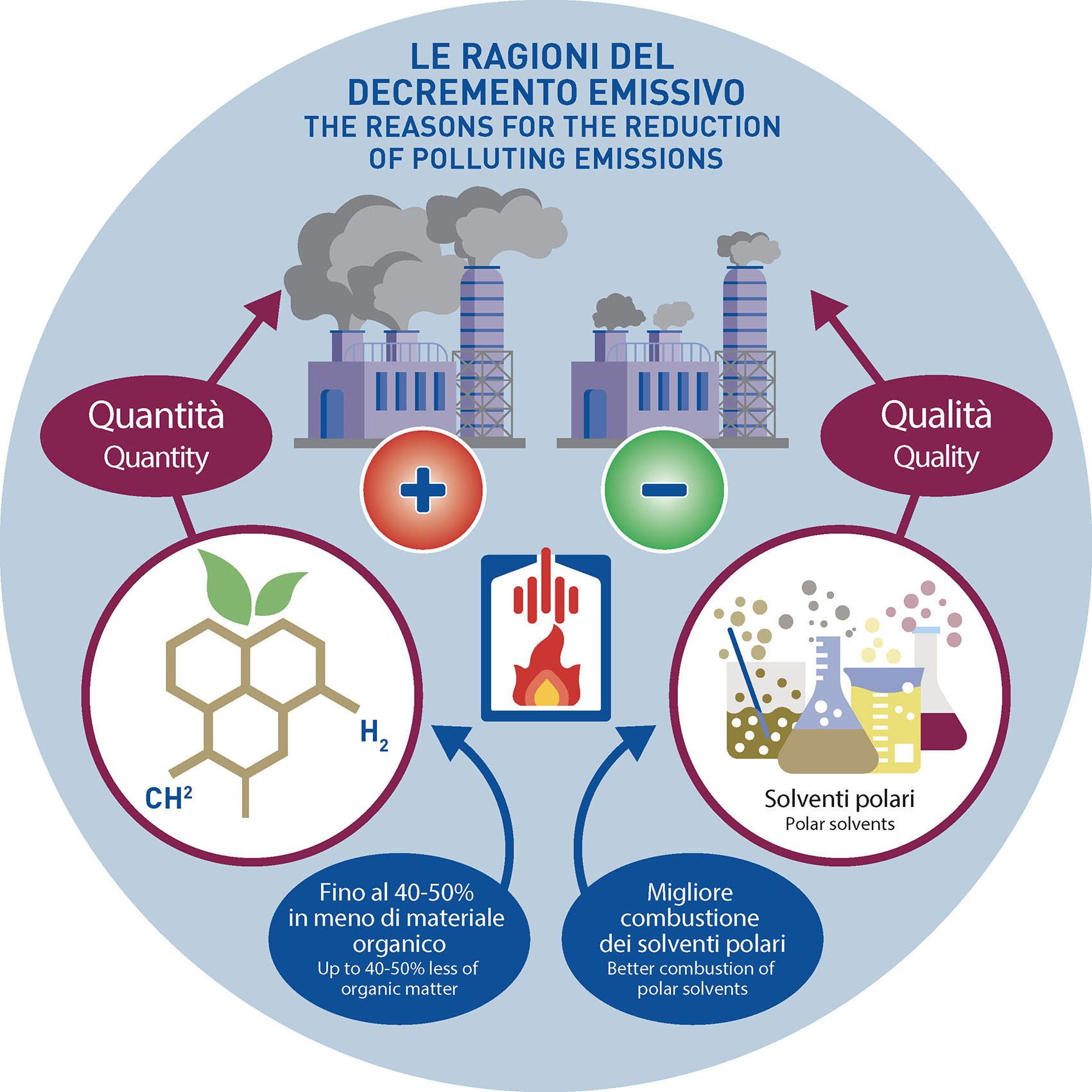
The use of water-based products within digital processes has shown a significant emission reduction of VOC, ALDEHYDES, and ORGANIC ACIDS that impact on the air quality. Two are the most important reasons.
- INTRODUCTION: WHAT HAPPENS INSIDE THE KILN
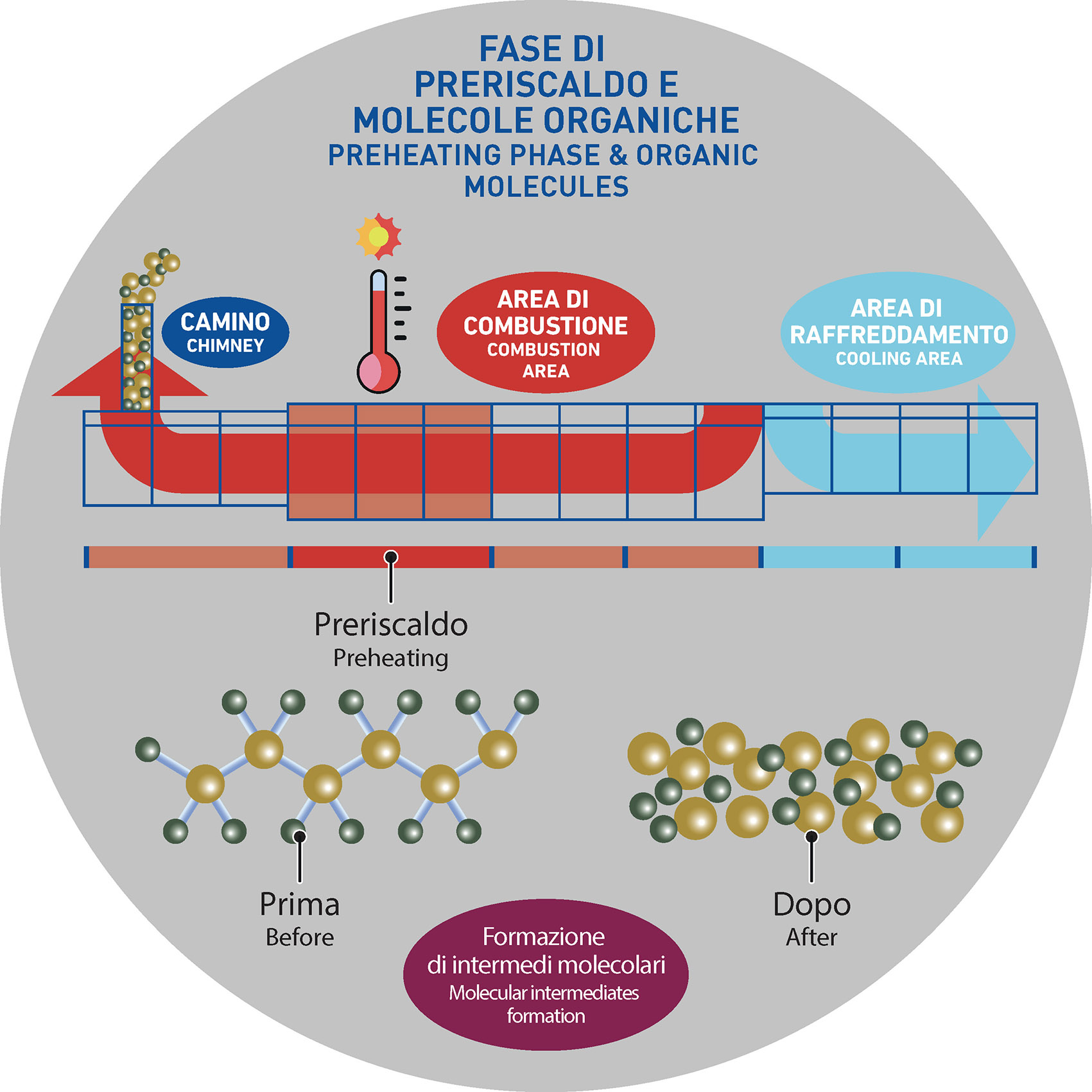
PRE-HEATING PHASE AND ORGANIC MOLECULES’ DECOMPOSITION
Ceramic kilns are primarily developed to reach the best firing condition for the inorganic components that make up the tile (sands, feldspar, clays, etc).
However, the pre-heating phase also leads to the evaporation process as well as to the partial decomposition of the organic materials of the ceramic body, including those of the glue.
Once the evaporation process has started during the pre-heating stage (in that area of the kiln where temperatures are not as high as those that are developed during the actual firing stage), organic molecules do not completely decompose but they produce molecular intermediates. The latter are free to move in the atmosphere of the kiln, easily reaching the chimney and therefore releasing polluting in the atmosphere.
- THE REASONS OF THE DECREASE IN EMISSIONS
QUANTITATIVE REASON
As we already pointed out, water-based digital glues contain up to 50% less of that organic material that is usually responsible for pollutions.
QUALITATIVE REASON
Unlike NON-POLAR solvents, POLAR solvents and the organic substances used in water-based digital glues are also marked by a chemism (set of chemical characters of a substance) that provides the glues with a better combustion process that in most cases leads to an important reduction of the polluting components.
3. Reduction of odor emissions
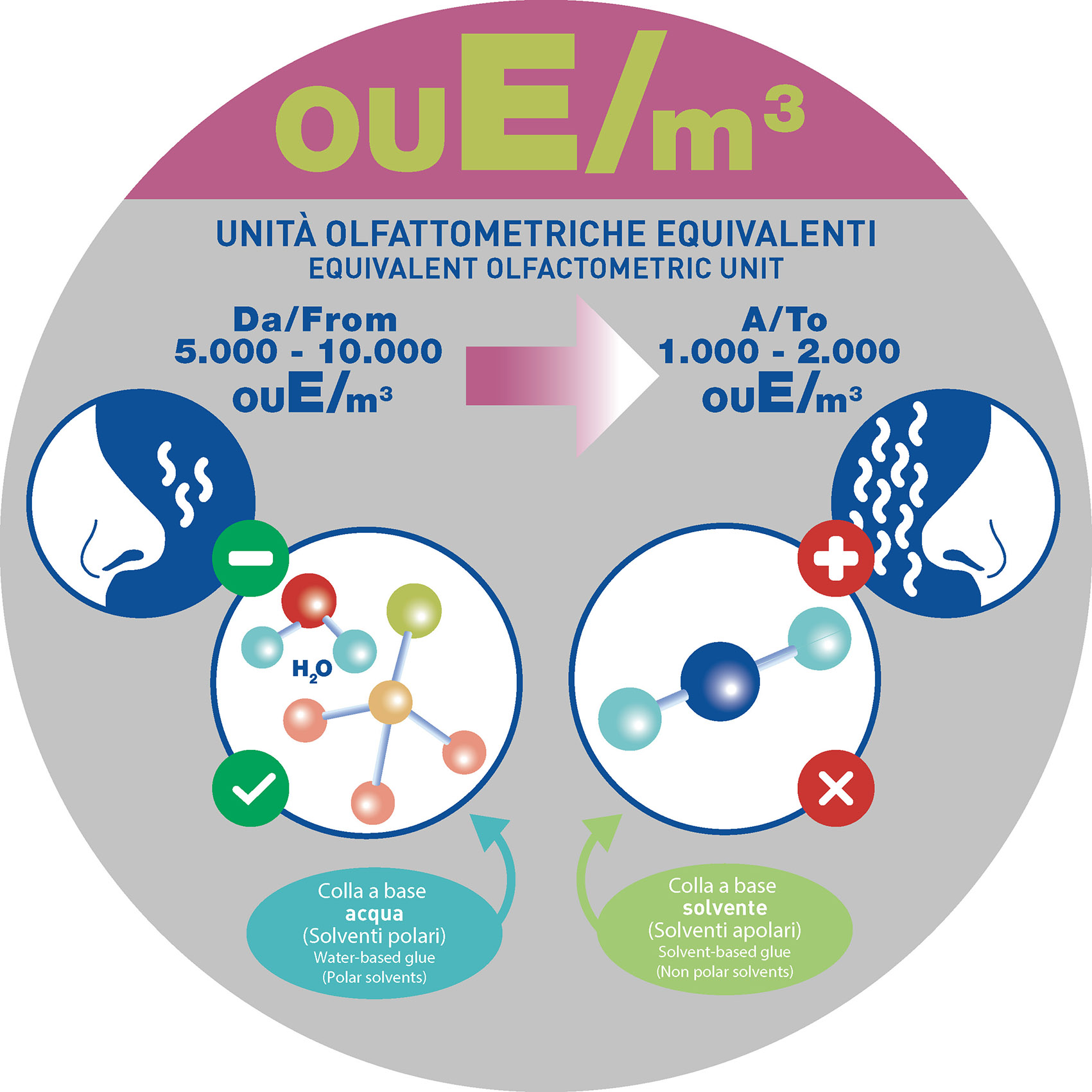
In general, the reduction can range from 5.000-10.000 ouE/m3 to 1.000-2.000 ouE/ m3: up to ten times compared to solvent-based systems (ouE = Olfactometric Unit Equivalent for m3).
This kind of measurement is usually able to define the concentration of odors in the air, translating a feeling in numbers.
What does that mean?
IT’S A MATTER OF CHEMISTRY
During combustion, the inorganic part of the glue (both particulate and not particulate) are fixed to the support (this happens both with water-based and solvent-based glues).
On the one hand, the non-polar solvents of solvent-based glues decompose in malodorous chemical compounds. On the other hand, the polar solvents specifically developed and selected for water-based digital glues produce, during decomposition, organic molecules (or molecular intermediates) with a very high odor threshold (the odors are detectable only in very high concentrations).
4. Technical and aesthetic features
Along with environmental benefits, water-based glues – thanks to their features – also offer several technical and aesthetic opportunities.
a) DRAINAGE TIMES
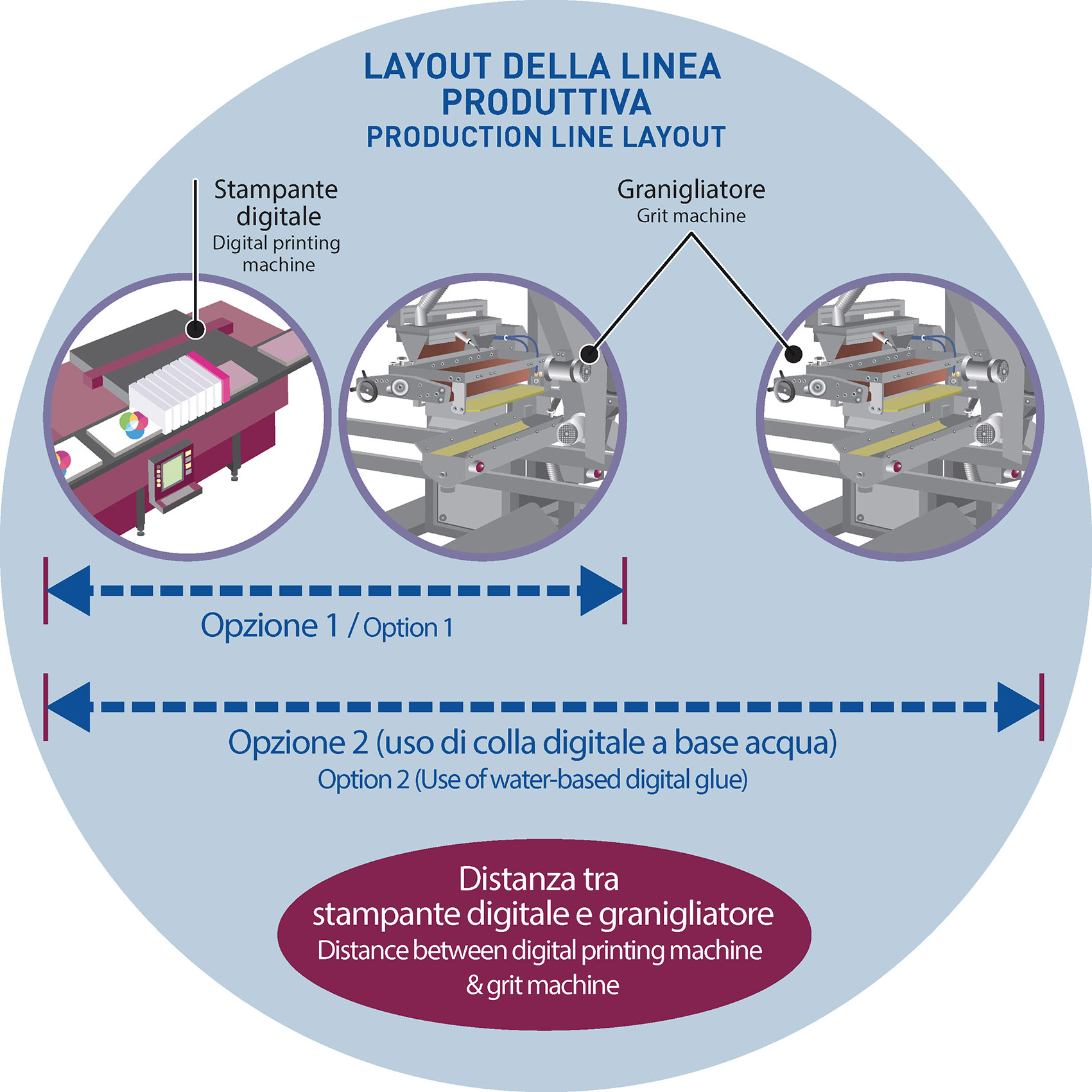
First, the longer drainage times provided by water-based digital glues allow manufacturers a greater flexibility with respect to the subsequent grit application. What does that mean?
It means that the shot blasting machine can be placed in different positions (and more specifically in a longer distance than that normally used with solvent-based digital glues). It may seem not significant but this is a very important technological benefit.
WHAT HAPPENS ON A TECHNICAL LEVEL?
- The special polymers used to develop water-based polar glues allows you to reduce the absorption of the glue by the ceramic support, therefore increasing drying times.
- With solvent-based glues, instead, both solvent and non-polar cohesive polymers tend to be faster and similarly absorbed by the support.
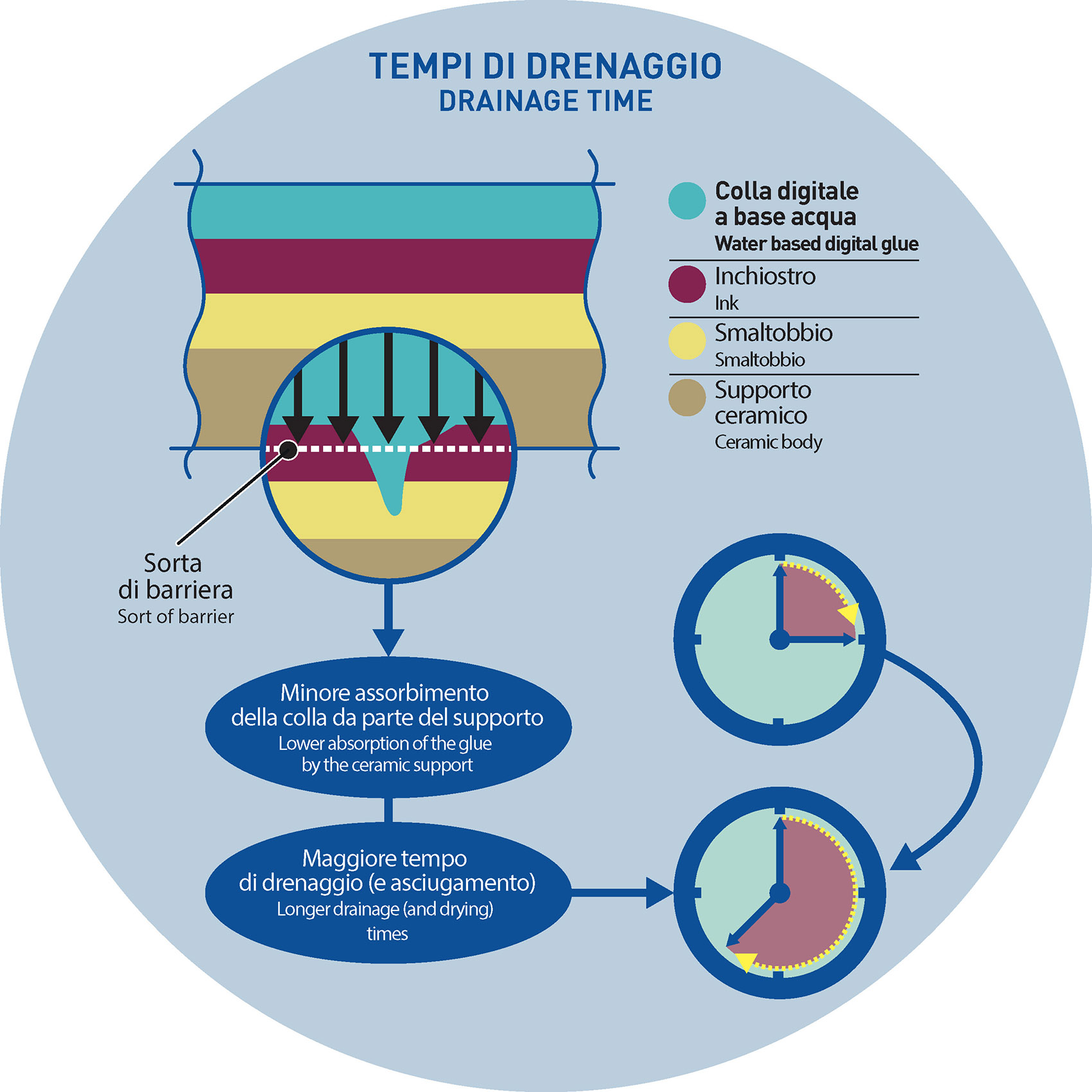
In other words:
- with solvent-based digital glues: both polymers and solvent are equally absorbed
- with water-based digital glues: polymers tend to remain on the surface, therefore creating a sort of barrier (the solvent is absorbed more than the polymers cohesive resins). This different kind of absorption affect the drying times, increasing those of water-based digital glues.
b) LEVELING POWER (surface tension)
The formulation of water-based digital glues must be carefully studied in terms of superficial tension, since they must interact with solvent-based digital inks currently used in the digital printing process.
The study should take into consideration:
- the application’s dynamic stage (when the glue is discharged by the nozzles)
- the application’s static stage (when the glue has been already spread on the ceramic support)
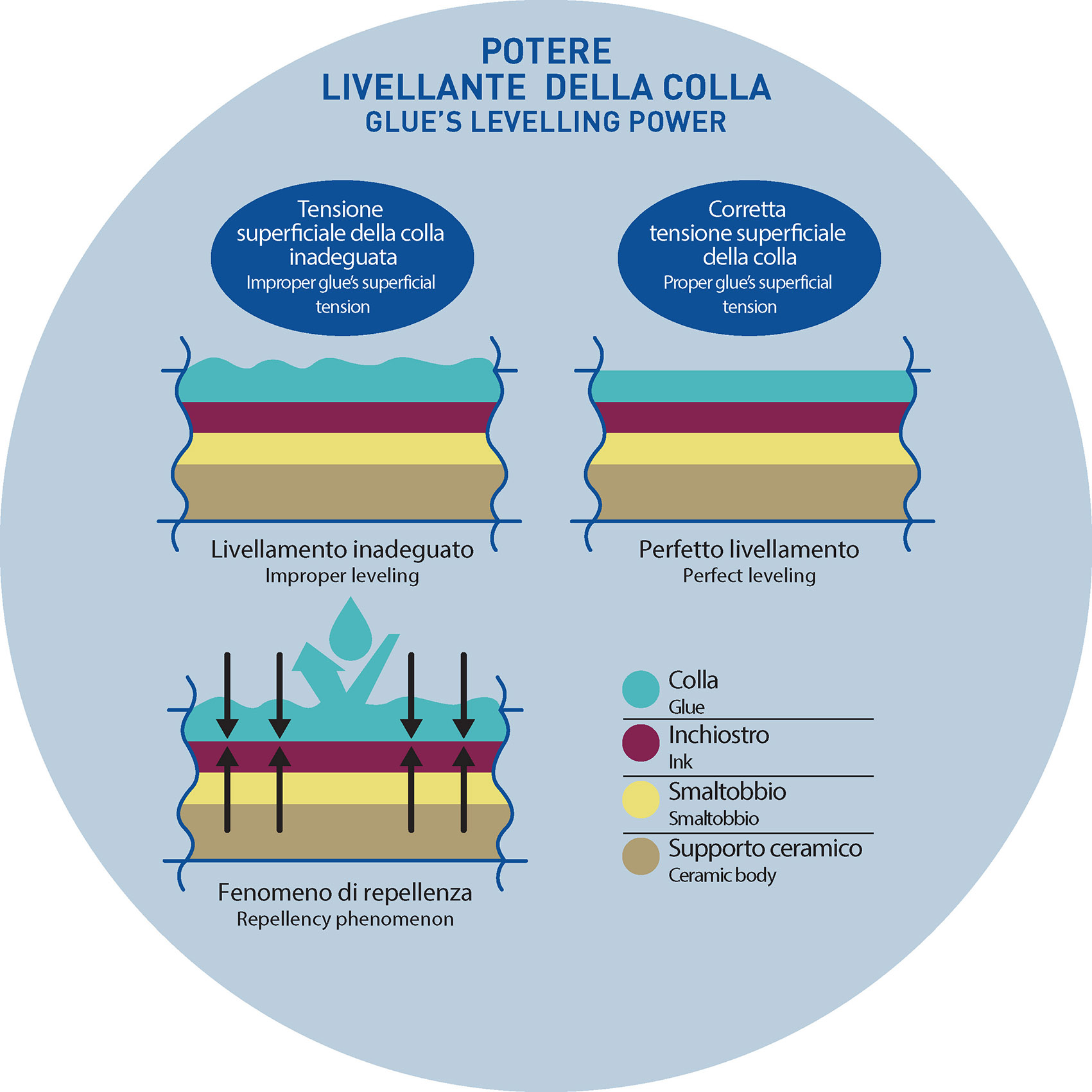
The proper surface tension is, in fact, one of the preconditions to get a perfect leveling of the glue on the previous ink application: the point of contact between the two – the interphase – must be marked by a great compatibility value to avoid the problems that may compromise the following stages of the process. For example, the repellency phenomena deriving from the different chemical nature of inks and glues. Such compatibility, and therefore a high-performing levelling, can be achieved by working on the surface tension of the two products/components.
c) BETTER PRINTING DEFINITION
SOLVENT-BASED GLUES
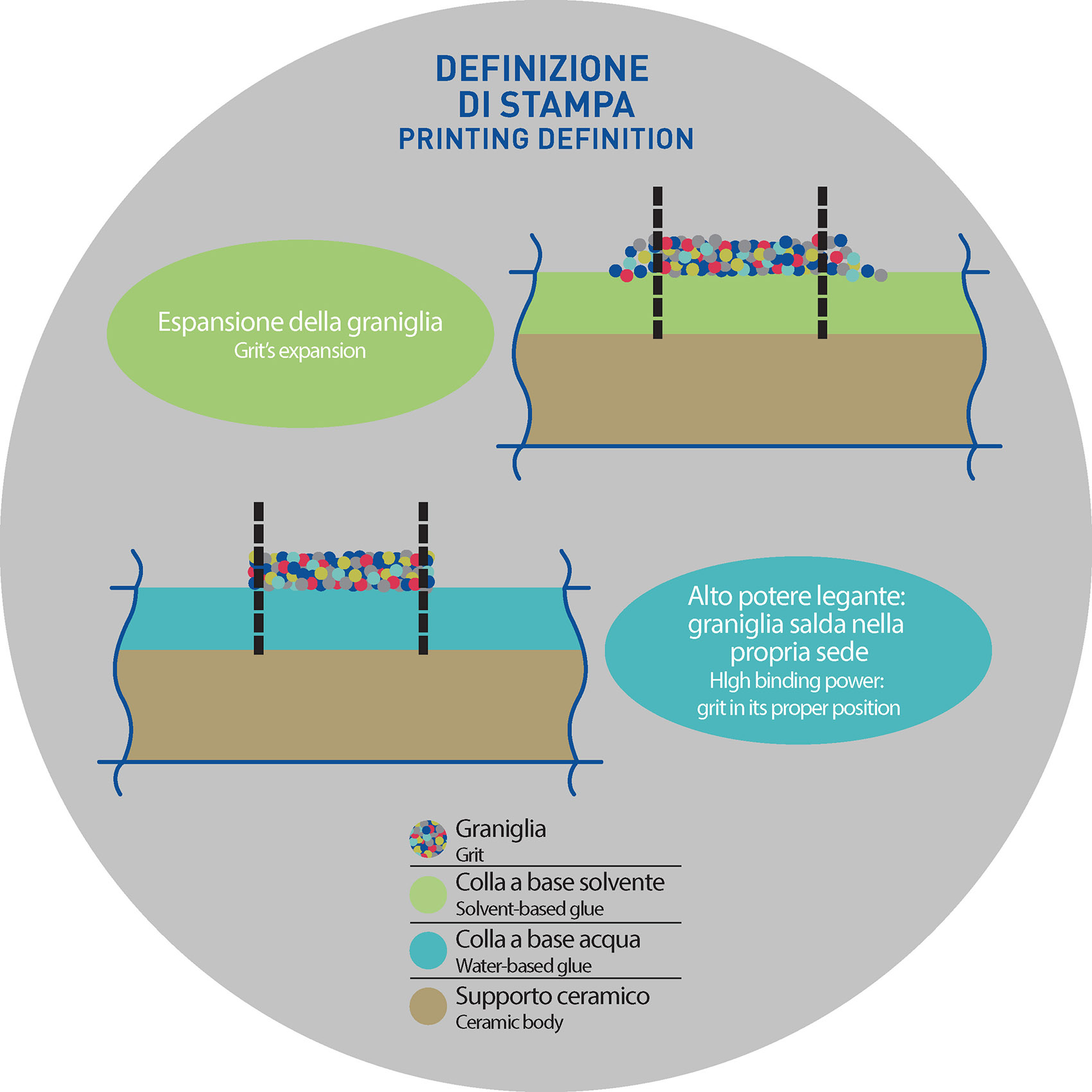
Solvent-based digital glues – as well as all digital inks applied in large amounts (actually, digital glues can be totally compared to inks) – tend to expand on the ceramic support, leading to a loss of grit definition.
In fact, they are more rapidly absorbed by the support due to the equal capillary migration of the solvent and the cohesive polymers: not only inside the support but also on the surface.
WATER-BASED GLUES
With water-based digital glues, instead, the solvent (and primarily the water) tends to be rapidly absorbed by the support and the cohesive polymers are fixed to the surface producing a sort of “absorption barrier”, thus preventing the glue’s upper layers to drain into the support without expanding. Such phenomenon improves the definition of the discharged grit.
d) IMPROVED MANAGEMENT OF THE AMOUNT OF GRIT
BINDING POWERS IN COMPARISON
Another important feature of water-based digital glues is their higher binding power.
The solvents normally used in solvent-based digital glues can be considered as a sort of oil that reduces, or even cancel, the binding power of the glues. Why? Basically, the resins in solution remain, solvated (that is surrounded by the solvent that acts as a gap between the resins and the grit) preventing an intimate bond between the support and the grit.
The resins’ binding power of water-based digital glues is instead promoted by the water itself. In this case the maximum binding action occurs after the water evaporation process: polymers and cohesive resins – once they have lost water contents and so the solvation has come to an end – bind together and with the ceramic support. The high binding power of the glue strongly fix the grit, increasing the printing definition.
MANAGEMENT OF THE AMOUNT OF GRIT
The two different glues, because of their different binding power, act differently on the grit. Water-based glues, in fact, allow you to better manage – even simultaneously – high, medium, and low amounts of grit.
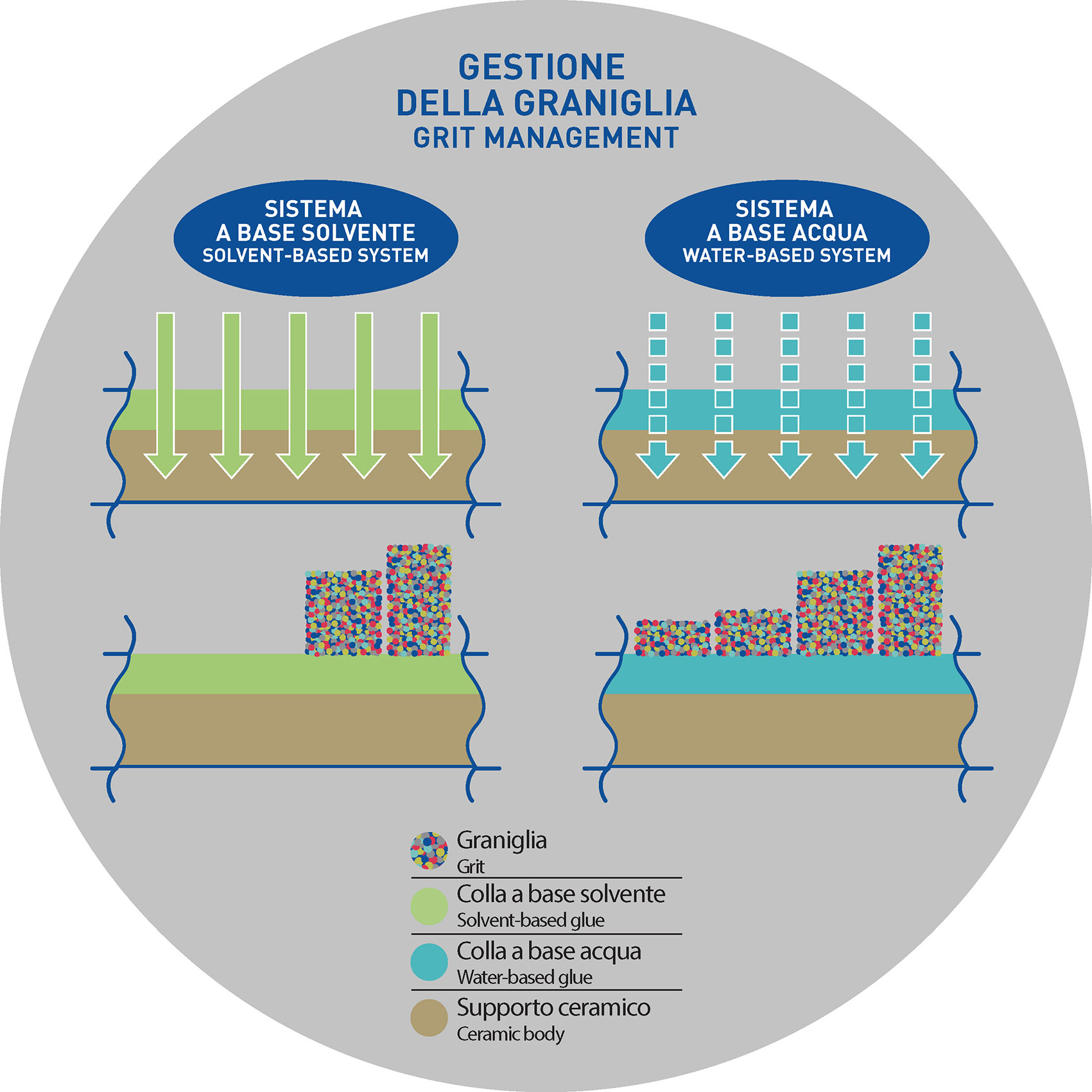
Solvent-based digital glues, due to their low binding power, do not correctly manage medium and low weight of grit. To do this, in fact, an important amount of glue would be required.
The high binding power of water-based digital glues helps and improves the simultaneous application of medium and low contents of grit. This technical option clearly expands the possibilities in terms of creativity and development of the ceramic project.
FOCUS
SOLVENTS
In chemistry, a solvent is a substance (usually liquid) that solubilizes other substances without reacting with them.
Solvents are usually classified as polar or non-polar solvents according to their polarity (whether they are organic or inorganic). The polarity of a molecule depends on several elements but – trying to simplify – we could generally say that all symmetric molecules are non-polar while all asymmetrical molecules are polar.
The polarity of a solvent shall determine the kind of compounds the solvent can dissolve as well as the nature of the other solvents and/or liquids with which it can be blended. Polar solvents normally better dissolve polar compounds just like non-polar solvents take more easily action on non-polar compounds.
THE MOLECULES’ SHAPE
In general, the features of a substance mostly depend on the shape of its molecules. In a molecule, atoms are arranged according to specific geometric relationships that provide the substance with precise properties. The geometry of a molecule is also defined by the bond angle that is the angle formed by the axis that link together the different nuclei of atoms. The geometry of a molecule, i.e.
the arrangement of its molecular bonds in space, affects its polar or non-polar nature. The molecule can be defined as polar when the sum of the dipole moments of its bonds is not zero.