Complexation
Complexation is a chemical reaction that produces coordination complexes.
A coordination complex is a chemical compound consisting of a central atom or ion, which is usually metallic and is called "coordination centre", and a surrounding array of bound molecules or ions, that are in turn known as ligands or complexing agents.
During a complexation reaction, chemical bonds are formed between a central atom or ion and other chemical species in numbers greater than the oxidation number of the atom or the central ion.
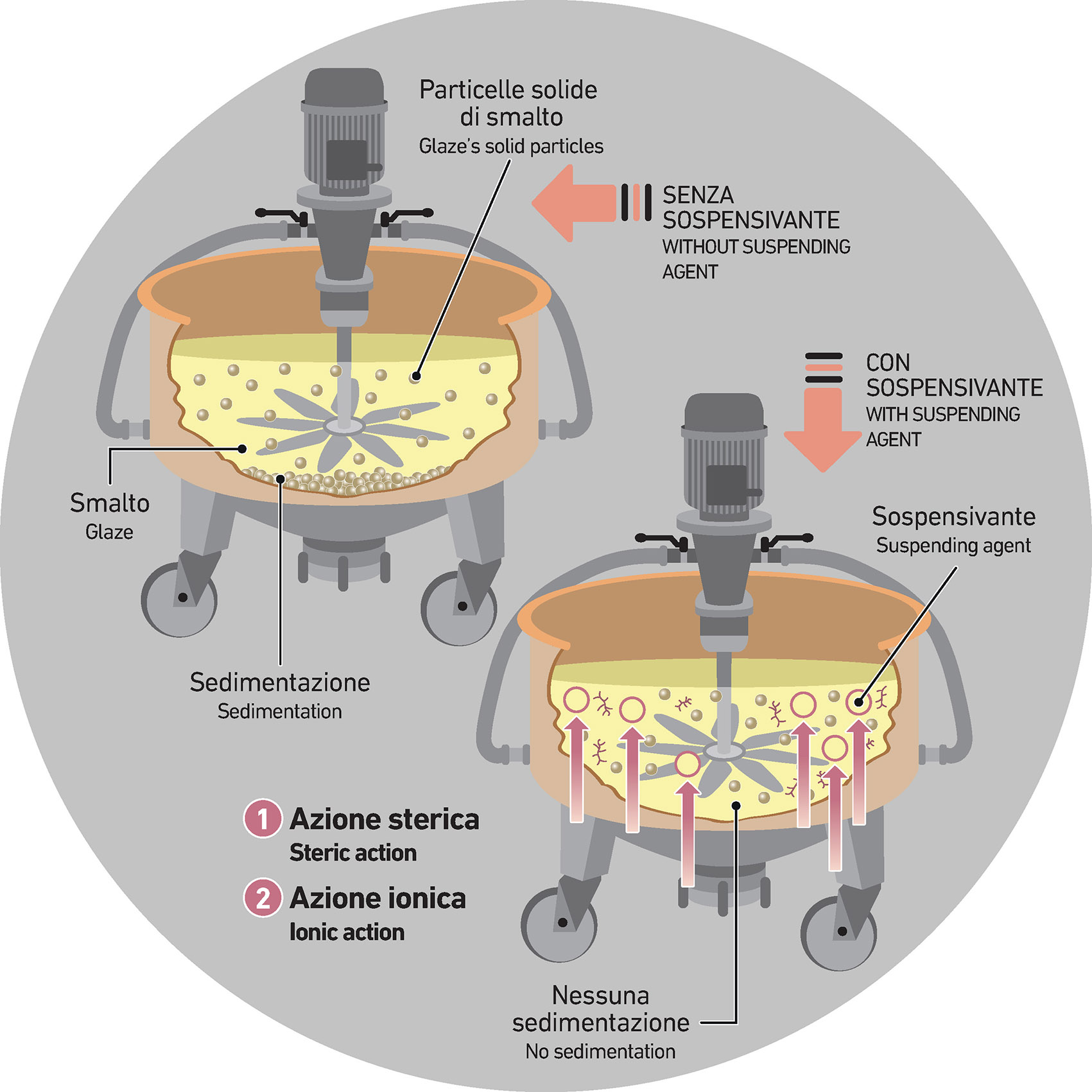
In Ceramics, complexing agents consist of particular chemical molecules (sodium salts) equipped with functional groups containing atoms that provide the system with a very negative electronic charge.
When added to the ceramic mixture, the complexing agents release sodium (monovalent cation) preferentially attracting multivalent cations. The result of this electrostatic process facilitates cation exchange with a consequent increase in the distance between the particles and a decrease in viscosity, containing if not eliminating flocculation phenomena.