#72 Back meshing of large ceramic slabs: safety, strength, and process control



Content
- Why reinforce the back of a large slab?
- Not only for ultra-thin slabs
- The mesh: a fiber network that works together with the slab
- A dedicated back-meshing line
- From adhesive to mesh: how the system is applied
- Airless and comb application
- Temperature and viscosity: two closely linked parameters
- Metering and mixing the two components
- Thermal treatment: from application to full cross-linking
- How reinforcement performance is assessed
- Fire behavior
- Every line has its own balance
The growing use of large ceramic slabs has significantly expanded the range of ceramic applications, taking the material well beyond its more traditional uses. Large surface areas, reduced thicknesses and new applications have also introduced specific requirements in terms of handling, processing, installation and safety.
This is where back meshing comes into play. It is a post-firing process that generally involves applying a reinforcing mesh or mat, usually made of glass fiber, to the back of the slab and bonding it to the ceramic surface with an adhesive system.
1. Why reinforce the back of a large slab?
One of the main functions of back meshing is to improve safety in the event of breakage.
The mesh applied to the back helps hold the slab fragments together if the slab breaks. This is particularly important in vertical applications, where falling fragments could pose a risk to people and property.
For this reason, back reinforcement is used, for example, in wall cladding and façade applications, including certain façade systems in which slabs are installed vertically.
However, the function of the mesh is not necessarily limited to containing fragments. The reinforcement can also improve the slab’s behavior during handling, cutting, drilling and other processing operations, reducing the risk of cracks spreading.
Back meshing can also contribute to impact resistance. Depending on the system used and the characteristics of the slab, the support provided by the mesh and resin can make the product more resistant to certain types of mechanical stress.
The treatment can therefore serve two purposes: on the one hand, it can improve safety in the event of breakage by helping to keep fragments together; on the other, it can provide additional reinforcement during some of the stresses the slab may encounter in subsequent processing, transport, handling and use.
2. Not only for ultra-thin slabs
Back meshing is often associated with large, thin slabs, where the combination of very large dimensions and a thickness of just a few millimeters make the management of mechanical stress particularly important.
However, the technology is not necessarily limited to ultra-thin slabs.
Reinforcement can also be applied to thicker products when their intended use, size, subsequent processing or specific safety requirements make it appropriate. Thickness alone is therefore not the deciding factor; what matters is the combination of the product’s characteristics and the performance required.
3. The mesh: a fiber network that works together with the slab
Glass fibre is the material most used to reinforce the back of large ceramic slabs.
The mat generally consists of glass-fiber yarns arranged in a mesh structure. Its characteristics – from mesh size to geometry – can vary depending on the product and the required performance. Surface treatments or coatings on the mesh may also differ and can help protect the fibres and improve their behavior during subsequent processing and application stages.
In the back-meshing process, however, the mesh does not work on its own. To perform effectively, it must be properly bonded to the back of the slab with an adhesive system, creating an integrated structure with the ceramic surface.
Since the type and characteristics of the mesh can vary according to specific application requirements, compatibility with the adhesive system is also an important part of the process. The aim is to ensure effective bonding and reliable performance under the specific conditions of industrial processing.
4. A dedicated back-meshing line
Back meshing is carried out on the fired product using a dedicated line that integrates the various operations required to apply the reinforcement in sequence.
In automated configurations, the slab is moved along the line on a roller conveyor and oriented so that the back is accessible for application of the adhesive system and mesh. When necessary, a device turns the slab by 180°, positioning the finished surface face down and the side to be treated face up.
The process then continues through a coordinated sequence of operations: adhesive application, mesh positioning and cutting, spreading, and a subsequent thermal treatment stage, depending on the plant configuration.
The line is therefore specifically designed not only to apply the different materials, but also to manage the correct sequence, processing times and handling of slabs that can reach considerable dimensions.
5. From adhesive to mesh: how the system is applied
The adhesive system, i.e. the system of additives required to bond the mesh, is first applied to the back of the slab.
One possible technology is airless application, in which the components are metered, mixed and applied to the surface. In two-component systems, such as those offered by Zschimmer & Schwarz Ceramco, mixing must take place sufficiently close to the point of application because, as soon as the two components come into contact, the chemical reaction that progressively forms and cures the polyurethane begins.
In the process considered here, the product begins to react within the first few seconds after mixing, while retaining enough open time for the subsequent operations: uniform adhesive distribution, mesh placement and spreading.
The mesh is normally fed from a roll and can be laid automatically onto the surface. It is cut to match the dimensions of the slab and placed onto the adhesive while it is still workable.
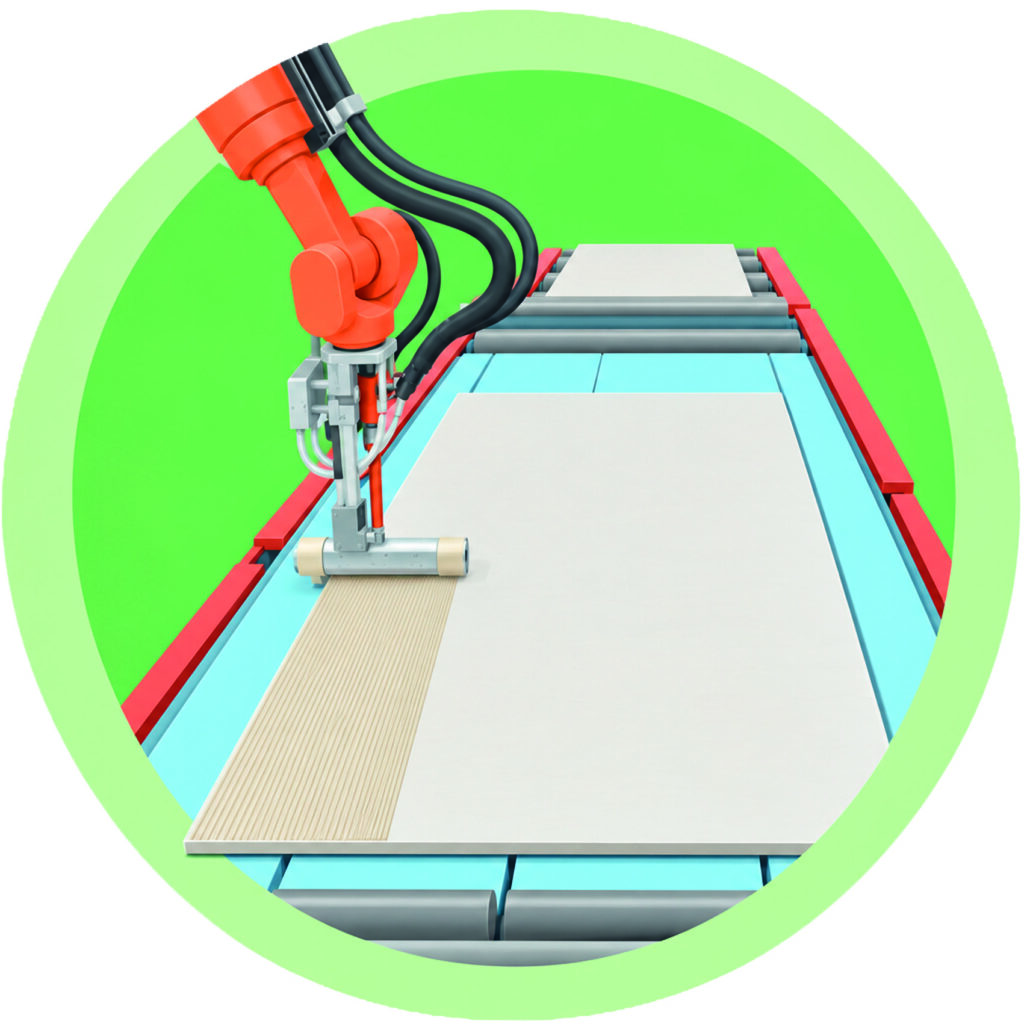
An automatic system – which may include, for example, an articulated robotic arm fitted with a spreader – then applies mechanical pressure to the mesh. The spreading action helps flatten the mesh, distribute the adhesive and ensure contact between the different elements of the system, contributing to an even application across the entire surface.
6. Airless and comb application
Airless spraying is not the only possible method for applying the binders.
In some configurations, the product can be applied using a comb system, which deposits the mixture onto the surface in successive passes. The applicator can be mounted on a robotic system and move across the slab until the required area is covered.
Here too, once the product has been applied, the mesh is positioned and a subsequent spreading operation helps even out the system and ensure proper contact between the adhesive, fiber and ceramic substrate.
The properties required of the adhesive – and therefore its formulation – can also vary depending on the application technology. A product designed for airless application, and one intended for a comb system may, for example, require a different balance between viscosity, application temperature, workability and open time. With airless application, overspray must also be managed, i.e. the sprayed material that does not reach the target surface directly. In some plant configurations, a continuously moving protective paper is therefore placed beneath the slab to prevent contamination of the rollers and other parts of the line. The paper is unwound during application and then collected by a second winding system.
7. Temperature and viscosity: two closely linked parameters
Temperature control is particularly important when handling certain two-component polyurethane systems.
In general terms, the polyol component – NEOPUR, the product promoted and offered by Zschimmer & Schwarz – may have a relatively high viscosity at room temperature. To make pumping, metering and, above all, application easier, it may therefore be useful to bring it to a higher temperature.
In the system considered here, the operating temperature is approximately 35–40 °C. Increasing the temperature reduces viscosity and helps achieve a more even distribution of the product.
The isocyanate component – ADIFLEX, the product promoted and offered by Zschimmer & Schwarz – is also kept at a controlled temperature, although its viscosity characteristics may differ from those of the polyol component.
Temperature control does not necessarily apply only to the tanks. On dedicated lines, pipes and transfer circuits can also be temperature-controlled to keep the product under the required conditions up to the point of mixing and application.
The system may also include a recirculation circuit: when the applicator is temporarily stopped, the components continue to circulate separately through their respective lines rather than remaining stationary in the pipes. This helps maintain more uniform temperature and process conditions.
8. Metering and mixing the two components
Correct mixing is essential to achieve the expected performance of the polyurethane system.
In the process considered here, the mixing ratio is approximately four parts polyol components to one part isocyanate component. However, this parameter depends on the specific formulation. The mixing ratio of a two-component system should not be regarded as a universal value, as it depends on the chemical composition of the two components and the stoichiometry specified for that product.
Similarly, adhesive consumption depends on the surface, the mesh, the application conditions and the required performance. In the system considered here, the amount applied is normally around 220–250 g/m² of the two-component mixture.
The aim is to use enough material to ensure proper bonding of the mesh to the slab without compromising process consistency and repeatability.
9. Termal treatment: from application to full cross-linking
After the mesh has been positioned and spread, the reaction between the two components continues and the adhesive system progressively cross-links.
The slab can then be transferred to a thermal treatment unit, where heat promotes and accelerates the reaction, allowing the adhesive to reach a suitable degree of cure within a timeframe compatible with the industrial process.
In the system considered here, the slab generally remains in the thermal unit for around 20–25 minutes at temperatures of approximately 70–90 °C. These parameters are specific to the process examined: times and temperatures may vary depending on the adhesive formulation, plant characteristics and production conditions.
The polyurethane system can also cross-link at room temperature, but thermal treatment accelerates the process and reduces the time required before the subsequent processing stages.
When the slab leaves the thermal unit, the adhesive has reached a sufficient degree of cure for the process to continue, and the mesh is bonded to the ceramic substrate.
10. How reinforcement performance is assessed
The effectiveness of back meshing is not assessed by visual inspection alone.
One of the most important parameters is, of course, adhesion between the mesh and the ceramic surface. This can be evaluated using detachment tests based on the principle of peel testing, in which part of the mesh is left free so that it can be gripped and progressively peeled away from the substrate.
The test measures the force required to cause detachment, providing a quantitative assessment of the adhesive system’s performance.
Depending on the procedure used, the test can be carried out with equipment that records the peel force or by means of manual checks used for process control. Test methods and acceptance values must, of course, be defined according to the technical specifications adopted by the manufacturer.
These checks can be complemented by tests designed to assess the mechanical performance of the reinforced slab. These may include impact tests in which a mass is dropped from a defined height onto the surface, allowing the response of the product with and without reinforcement to be compared.
In general terms, the aim is to verify both the ability of the mesh to remain bonded to the substrate and the contribution of the system to fragment retention and to the slab’s behavior under stress or in the event of breakage.
11. Fire behavior
For some end uses, particularly in construction and in wall or façade applications, the fire behavior of the system can also become a relevant parameter.
The presence of an organic component – the adhesive – means that not only mechanical performance but also aspects such as reaction to fire and the material’s energy contribution in the event of combustion must be considered.
One of the parameters that may be considered is calorific value, i.e. the amount of energy a material can release during combustion. Depending on the intended use and construction system, specific fire-performance requirements or reaction-to-fire classifications may apply.
For this reason, the adhesive formulation can also be developed with these requirements in mind, with the aim of keeping the contribution of the organic component within the limits required for the specific application.
It is important to distinguish this aspect from the product’s behavior during application: the issue is not the heat generated while the adhesive is being mixed or used, but the behavior of the finished system if exposed to fire.
12. Every line has its own balance
At first glance, back meshing may appear to be a relatively simple process: apply an adhesive, lay a mesh and bond it to the slab.
In industrial practice, however, the balance between the different parameters is critical.
Application technology, viscosity, temperature, mixing ratio, applied quantity, open time, line speed and cross-linking conditions must all be compatible with one another.
Environmental conditions can also affect the process. The temperature inside the plant, for example, can alter the behavior of the adhesive and the available processing time. In some situations, the system may therefore need to be adapted to different seasonal conditions, potentially using specific formulations or settings for warmer or colder periods.
Before a product is fully introduced onto the line, it is therefore normally advisable to carry out an industrial trial.
The trial makes it possible to verify directly on the production line parameters such as viscosity and application behavior, correct metering, open time, the ability to position and spread the mesh before the reaction has progressed too far, final adhesion and compatibility with production times.
This is precisely where chemical formulation and the industrial process need to come together.
FOCUS:
a little chemistry – what are polyols and isocyanates?
To understand how the system works, it is useful to look at the chemistry behind it.
The polyol component contains molecules with multiple hydroxyl groups, while the isocyanate component contains functional groups.
When the two components are mixed, the hydroxyl groups react with the isocyanate groups to form urethane bonds. In a properly formulated system, this reaction progressively leads to the formation of a three-dimensional polymer network.
The system therefore changes from a fluid, workable state into a solid structure capable of firmly bonding the mesh to the ceramic substrate.
Polyurethane is the material formed through this reaction. Before mixing, it is more accurate to refer to the polyol component and the isocyanate component.
The formulation of the two components makes it possible to adjust both the final properties and the behavior of the system during application, adapting it to the requirements of the industrial process.sigenze del processo industriale.