#43 Chemicals and ceramic production: focus on deflocculants and binders



- Premise
- Deflocculants
- Binders
- Summary and conclusions
1. Premise
As is well known, most ceramic production processes involve the dispersion of ceramic powders in a liquid medium – mostly water – so as to get a suspension or, more generally, a dispersed system.
Depending on the different applications, to provide the suspensions with the desired characteristics of stability and workability, small quantities of appropriate chemicals are added, modifying the rheological behaviour of the entire system thanks to their interaction with the solid particles.
A ceramic disperse system can be extremely complex and yet its main components can be grouped within three large families:
- CERAMIC POWDERS
- DISPERSING MEDIUM
- ADDITIVES
The choice of the right additive and the right quantity to be added basically depends on the nature of the overmentioned components.
For example, chemicals suitable for stabilizing a clay in water may not be appropriate for stabilizing an oxide powder in an organic medium.
A first classification of all chemicals may be based on their main effect on the ceramic system to which they are added. Of course, a substance added with the aim of favouring or disfavouring a certain aspect can also give rise to desired or undesired secondary effects, therefore being included in more than one category.
The two most common categories of additives are deflocculants and binders. The former are used in order to reduce agglomeration phenomena between the particles and, therefore, to make the systems less viscous, while the latter are intended to create a lattice between the particles in order to provide the materials with a certain degree of elasticity.
In common parlance, the term deflocculant refers to a substance capable of decreasing the viscosity of a suspension, but this effect is only a consequence of the more fundamental outcome that leads to a reduction in the particles’ agglomeration.
In addition to deflocculants and binders, there are many other types of additives that can be added to improve the performance of the process and/or the product quality.
- Surfactants: to lower the surface tension of the system (in order to allow better wettability of the surfaces)
- Plasticizers: to modify the viscoelastic properties of the films that have been produced
- Defoamers and foaming agents: to counteract or promote, as needed, the formation of bubbles in the system
- Lubricants: particular surfactants added to reduce the friction between the solid parts
- Bactericides and Fungicides: to slow down biological degradation phenomena of organic substances promoted by the microorganisms (bacteria and fungi) present in the systems
2. Deflocculants
In the ceramic sector, terms such as dispersant and deflocculant are often interchangeably used.
It should be noted that by dispersant we mean the liquid phase in which solid particles are suspended. The term deflocculant refers to any substance that, when added in small quantities, reduces agglomeration phenomena between particles.
The definition of the word dispersant is, therefore, rather ambiguous because a dispersant effect can be reached by adding to the system both a dispersant and a deflocculant, even if they act quite differently.
The addition of the dispersing medium dilutes the system, lowering the viscosity value by a reduction of the volumetric content of the suspended solid components, leading in turn to a reduction in the possible interaction between the particles. The addition of a deflocculant limits the phenomenon of agglomeration between the particles while keeping the concentration of solids unchanged: it is only the reduction in the size of the agglomerates that lead to a lower viscosity value.
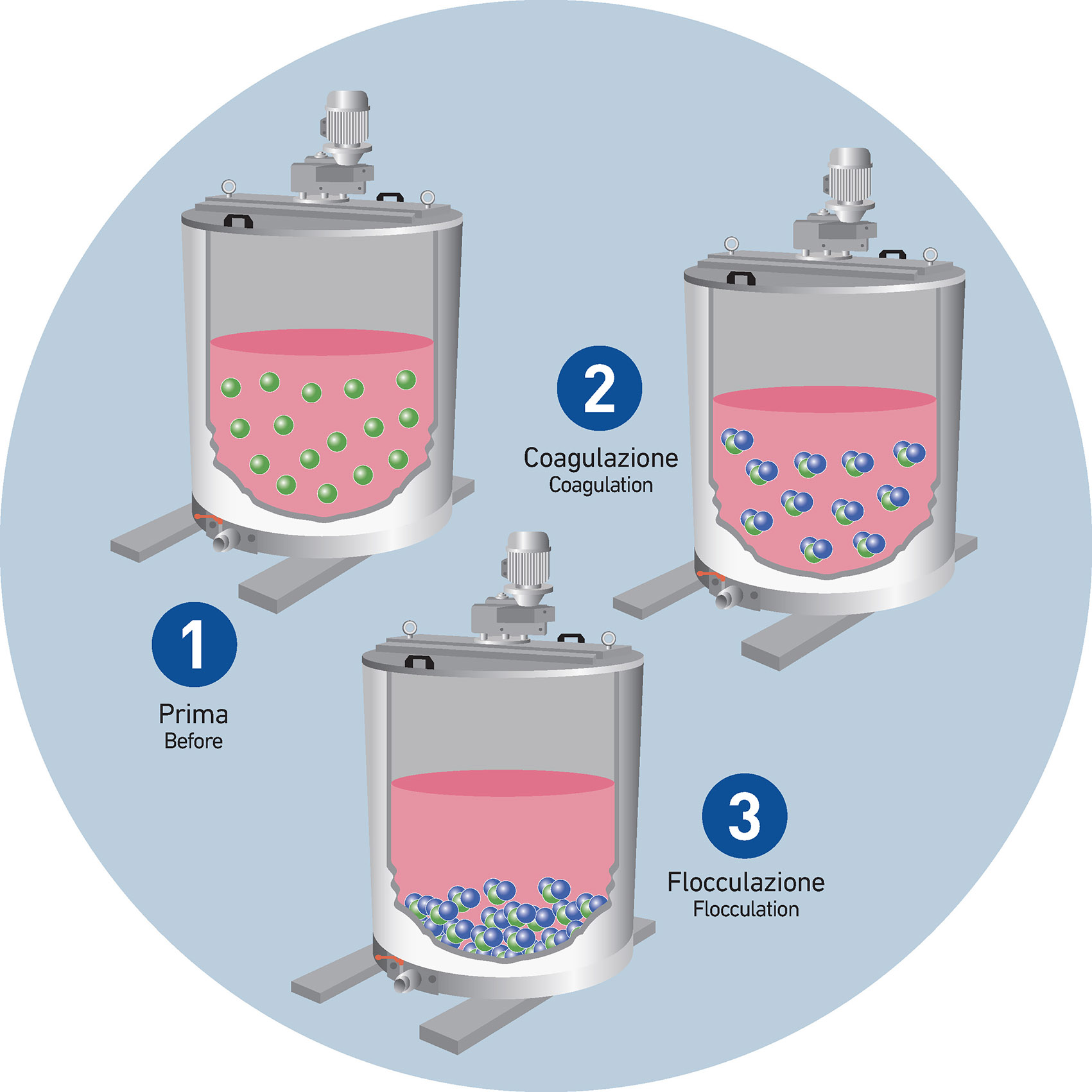
Although water is the most common dispersing medium in the traditional ceramic sector, for various applications it cannot be used and it is necessary the use of organic dispersing medium such as polyglycols or methyl ethyl ketone or trichloroethylene/ethanol mixtures.
As already pointed out, the amount of deflocculant to be added is a critical point in assessing its actual effectiveness.
3. Binders
As the name suggests, binders’ main purpose is to bind ceramic particles in order to produce a cross-linking effect within the system.
This structuring process, which can be considered a sort of flocculation process between particles, can be used for several and different goals. For example, the binder can be added with the aim of increasing the viscosity value of the systems (in this case we can speak of thickeners), or to modify their rheological behaviour, or to reduce sedimentation phenomena.
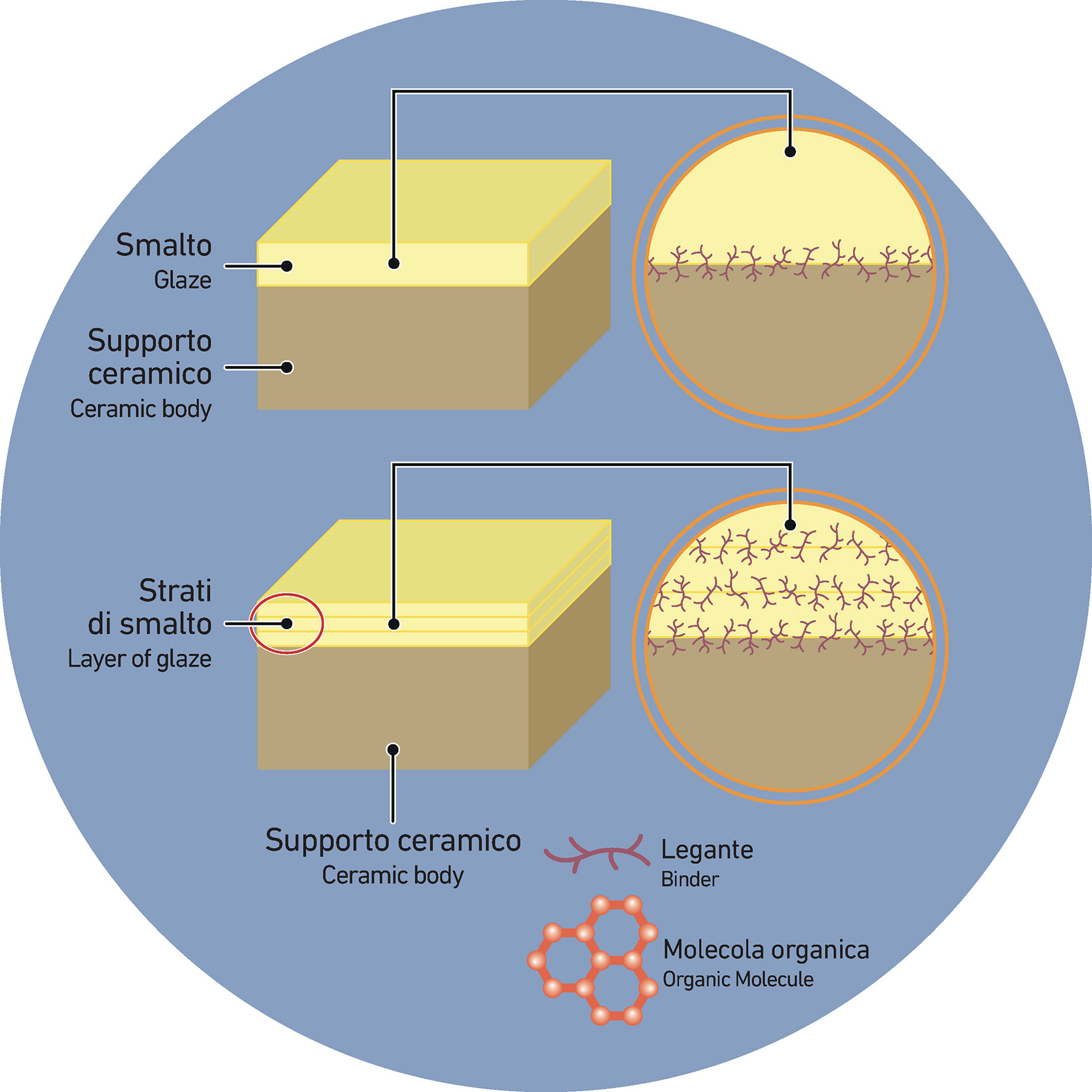
A category of binders used in traditional ceramic processes are colloidal particles that can be either inorganic (such as clay mineral particles) or organic in nature. However, the most widely used binders are polymers and various types of salts. The colloidal clay particles form agglomerates that, adsorbing onto the larger ceramic particles, connect them producing a lattice (a cross-linking effect). Polymer binders lead to the same outcome and, in particular the most common and widely used are vinyl, cellulosic and glycolic binders. These are mostly non-ionic binders, but provided with polar functional groups along the chain. All the rest are anionic binders with functional groups that become electrically charged once dispersed in the liquid and ionized.
4. Summary and conclusions
Colloidal stabilization of disperse systems involved in ceramic processes is a key step in controlling their rheology. To do this, it is often necessary to introduce appropriate deflocculants which, due to the electro steric effect, counteract the attractive forces within the suspension, reducing the degree of agglomeration of the systems.
The choice of the deflocculant depends on the nature of the solid particles to be stabilized and the dispersing medium in which they are immersed. The optimal amount to be used corresponds to the concentration capable of providing the system with the maximum stabilization without over-flocculating the system.
In addition to deflocculants, some systems also require the use of a binder that generally causes an increase in viscosity due to other and different flocculation phenomena that must be kept under control by acting appropriately on the chemical-physical conditions of the system.