Wettability
Wetting is the ability of a liquid to maintain contact with a solid surface, resulting from intermolecular interactions when the two are brought together.
It depends to a large extent on the angle of contact formed by the surface tensions of the surfaces or, more accurately, on the balance between the cohesion and the adhesion forces. When the adhesion forces are greater than the cohesion forces, the liquid tends to wet the surface, while when the adhesion forces are smaller than the cohesion forces, the liquid tends to "refuse" the surface.
For example, water is able to wet the clean glass, but it can not wet the wax.
In ceramics, wettability is very important since it may be responsible of a good or bad application of the suspensions applied along the glazing line.
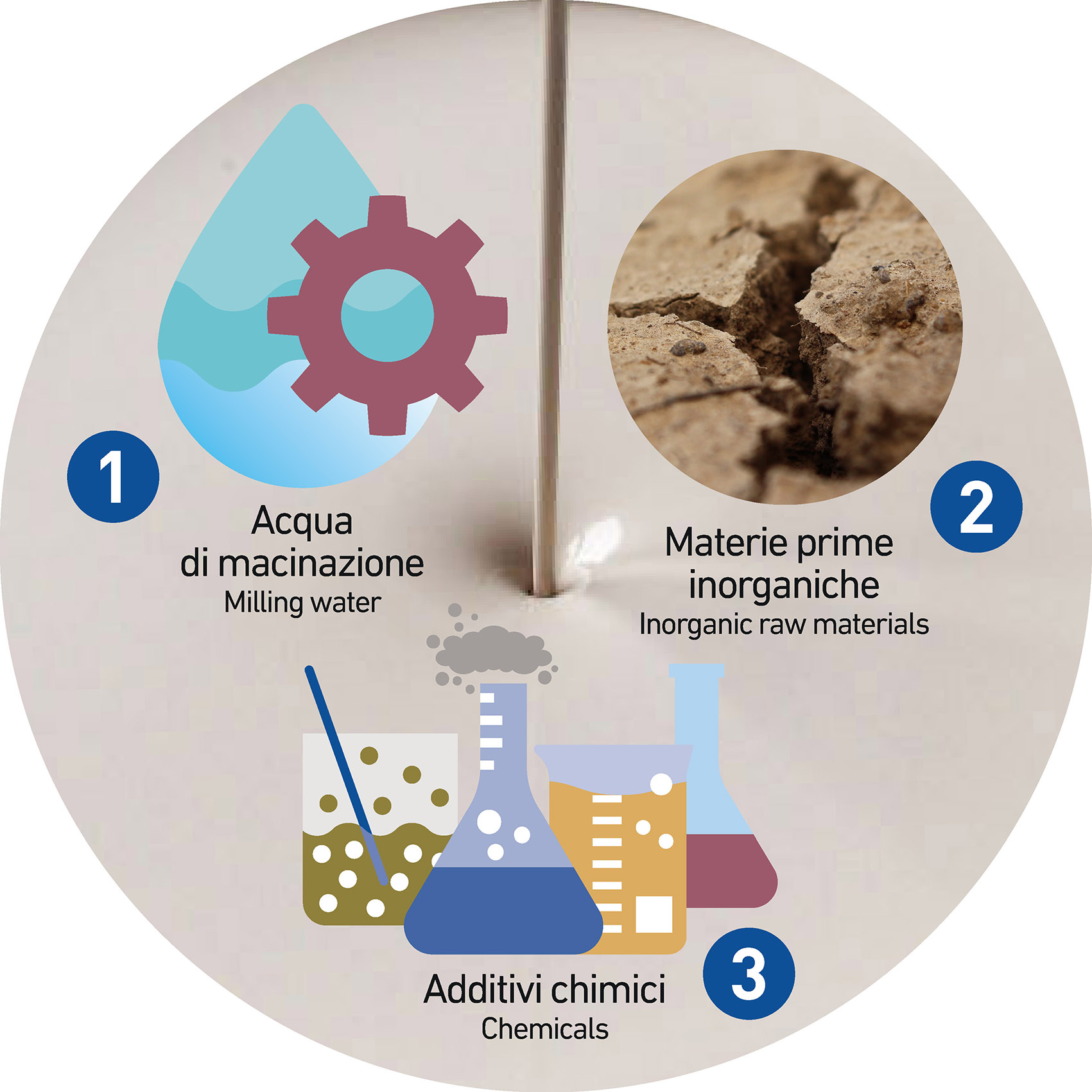
In this regard, for example, some categories of chemicals (such as wetting agents) can promote the wettability of inorganic particles in suspension (glaze, grit, etc.) by lowering the water'ssurface tension, just enough to counteract the agglomeration of the particles, facilitating their homogeneous dispersion within the system.
The decrease in the water's high surface tension – that usually prevents the water molecules to move within the agglomeration that keeps air inside – lets the water to surround and wet the suspended solid particles.
The de-agglomeration together with the lowering of the surface tension leads to a real levelling effect.