Sodium silicate
Sodium Silicate is a water-soluble inorganic material that effectively acts as a fluidifying agent, also promoting other relevant aspects.
Which are its most important features and actions?
It make it possible to decrease in the formula the amount of organic elements that, due to their decomposition, can lead to degassing phenomena during the firing cycle, therefore producing porosity in the final ceramic tile. For the same reason, the greater amount of inorganic material reduces the possible formation of the so-called black core during combustion.
Since it has a silica-based structure, Sodium Silicate can also facilitate the glass formation, thus beginning vitrification and sintering processes.
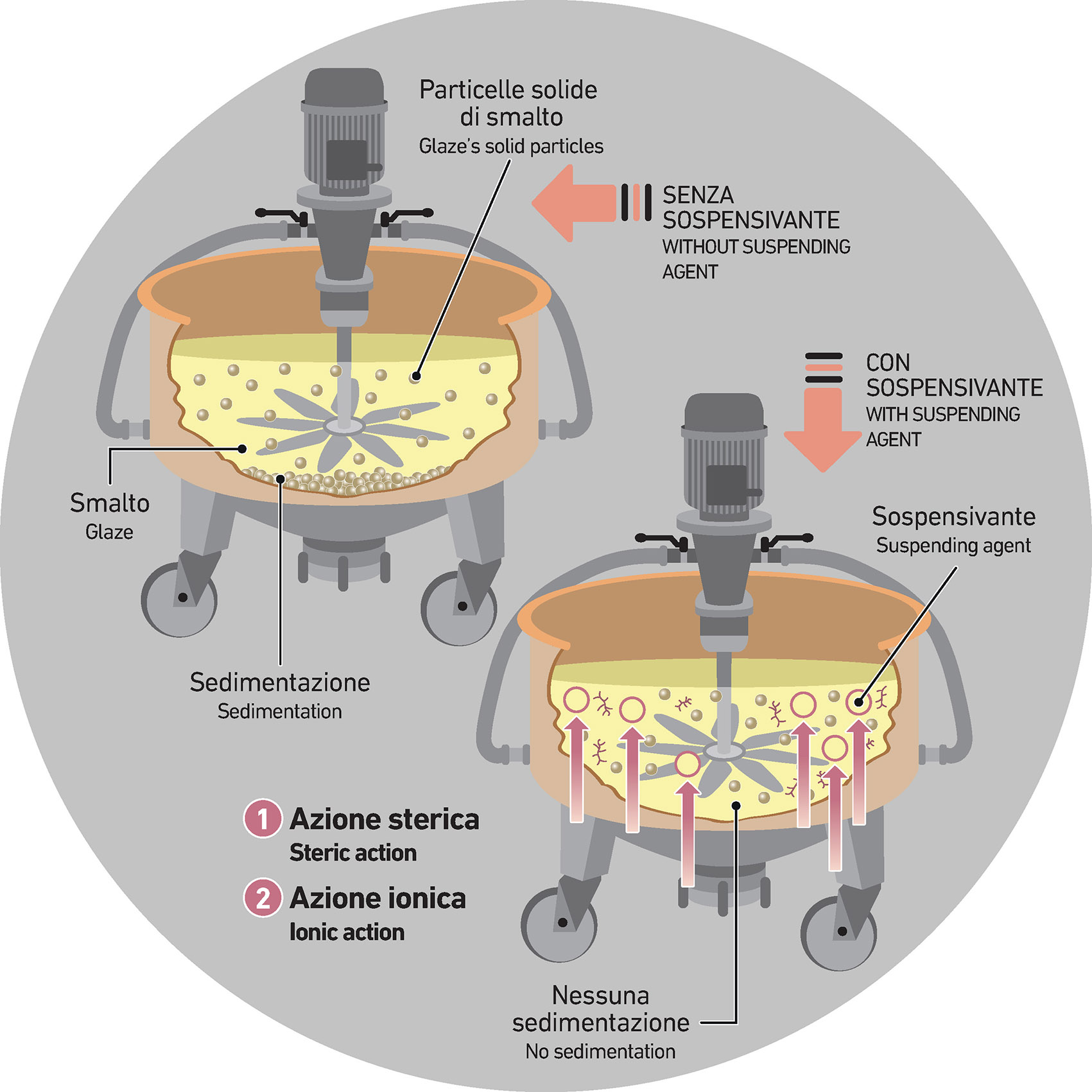
From a chemical point of view, Sodium Silicate (water glass) is a polimeryzed material in water suspension. It consists of a silicate polymeric chain in anionic form, in which Sodium is the cation. Sodium Silicate is therefore able to promote the three main mechanisms of the de-flocculation process.
ELECTROSTATIC REPULSION FOR CATION EXCHANGE
Sodium, performing as a monovalent cation, gives life to the cationic exchange with the bivalent and trivalent cations within the solution. This phenomenon reduces agglomeration phenomena, decreasing the system's viscosity.
STERIC REPULSION & COMPLEXATION
These very complex activities (that is not possibible to briefly summarize) depend on the Silicate and they both affects the system viscosity.