#67 TENACER: Z&S temporary binders



Advancing temporary binders to improve the mechanical strength of green ceramic bodies
In today’s ceramic manufacturing environment—marked by large formats, thin slabs, super-white bodies with a high glassy fraction, and increasing variability in raw materials—controlling mechanical strength has become one of the most sensitive variables across the entire production process. Achieving the right balance between spray-dried granule cohesion, slip workability, rheological stability, and press behavior has grown progressively more complex, especially in a context where clay quality and availability can no longer be taken for granted.
It is within this framework that the TENACER range, developed by Zschimmer & Schwarz, plays its role. The products were designed to increase granule toughness and enhance the modulus of rupture of the tile in the green state.
More broadly, discussing additives for ceramic production essentially means examining substances capable of regulating how water behaves throughout the various stages of the process. Water is a fundamental carrier in many steps of ceramic manufacturing—from milling to shaping—and along the glazing line, where aqueous suspensions follow one another continuously. When focusing specifically on binders, the residual moisture content in spray-dried powders is the parameter that gives the granule the plastic deformability required during pressing. At the same time, it can also become a potential source of instability: uncontrolled moisture levels—either too high or too low—makes powder difficult to compact and can generate defects that also affect the subsequent process stages.
Binders operate in close synergy with the water retained in the powders. Their action improves pressing performance by reinforcing the cohesion of solid particles and increasing the mechanical strength of the green body.
Addition method
Today, additives from the TENACER range are almost exclusively dosed in-line, immediately before spray drying. The practice of adding them directly into the main slip tank—common in the past—has gradually been phased out because it is difficult to control on large volumes and incompatible with the level of formulation precision now required. In-line injection enables far more accurate dosing and better dispersion, minimizing the risk of concentration gradients and allowing faster adjustment to production needs. Naturally, the binder’s impact on slip rheology must be carefully monitored. Any viscosity variation must remain within limits compatible with spray drying, and particular attention must be paid to preventing localized gel formation or inhomogeneity at the injection point, which could otherwise compromise the entire system.
Main product families: Series 400 and Series 700
The TENACER range is primarily structured around two core families—Series 400 and Series 700—which differ in their prevailing chemical composition and technological approach.
Below is the product structure as of March 2026 (the Z&S portfolio evolves continuously in step with application technologies and market requirements).
400 – Formulation concept and concentrationoni
The 400 series is mainly based on synthetic resins, sometimes supported by additional organic additives. This line can be described as a technological platform that emphasizes the polymeric component, using macromolecular chains capable of creating a more extensive and robust cross-linking structure within the spray-dried granule. From a theoretical standpoint, synthetic resins can offer higher cohesive potential than naturally derived binders, since polymer length and architecture can be engineered to deliver improved mechanical properties and stronger interactions among solid particles. In practical terms, this translates into a high level of customization.
Technically speaking, it is possible to adjust the nature and concentration of the resins, modify polymer chain length, and tailor the formulation to meet the specific requirements of each customer. Field experience has confirmed the potential of this flexibility in particularly demanding scenarios. For example, trials were carried out with spray-dried powder intended for third-party use and transported in big bags, where the ability of the granules to withstand transport became a critical parameter. In such cases, the binder had to do more than simply increase the modulus of rupture: it also had to ensure that the granules did not crumble before reaching the press.
These experiences have shown that formulations leaning strongly toward a synthetic approach can sometimes deliver outstanding performance, although they require careful balancing to avoid stability issues or complications in industrial handling.
700 – Formulation concept and concentration
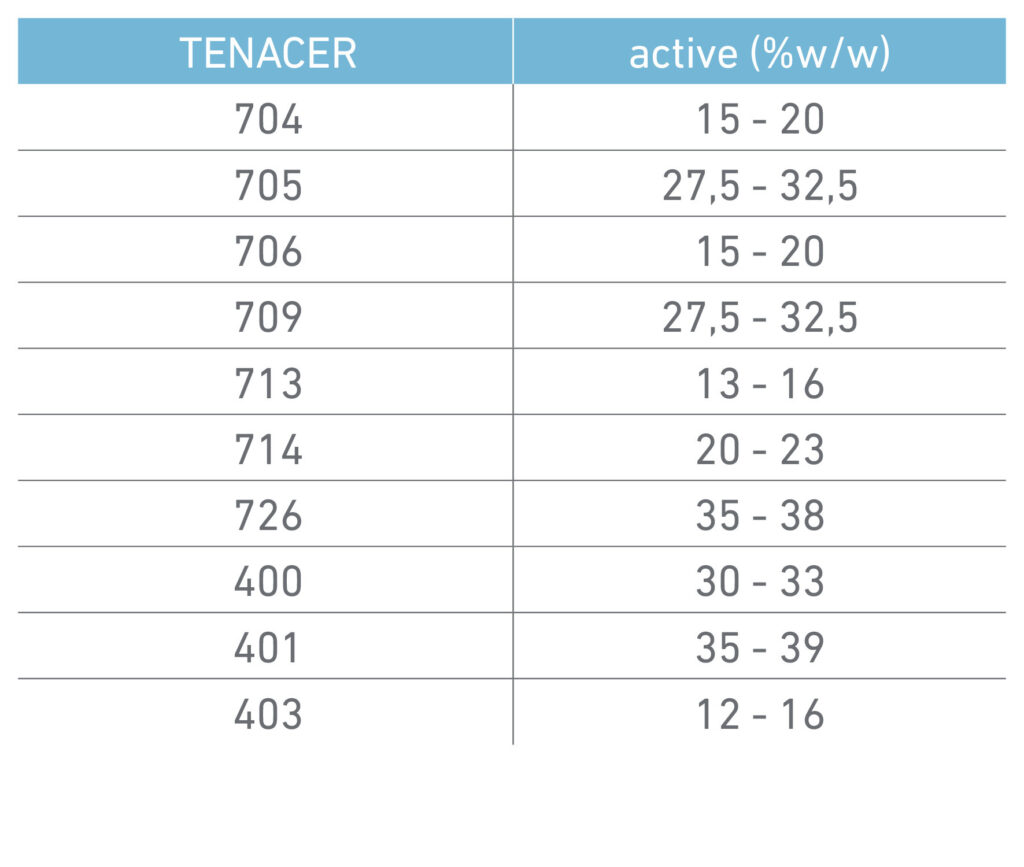
If the 400 series represent the highest level of technical customization, the 700 series stand out as the most dynamic and versatile from an industrial standpoint. Its base is primarily organic—derived from naturally sourced binders—although more recent developments also incorporate synthetic components. One of the most delicate aspects in designing the 700 series lies in the water solubility of its components. Every substance has a solubility limit beyond which the system becomes unstable. In addition, increasing concentration does not produce a linear viscosity increase; rather, viscosity can rise exponentially, potentially leading to gel formation or storage difficulties. Achieving the right balance therefore requires a deep understanding of raw-material interactions and careful management of free water content in the formulation.
Below is the concentration of active matter in the formulations currently available on the market:
Industrial experience across multiple production environments clearly shows that a binder additive cannot be considered an independent or self-sufficient solution. Instead, it must be evaluated within a complex manufacturing system made up of numerous interrelated variables. For example, in plants producing large slabs that are subsequently cut into smaller formats, cutting operations can generate micro-cracks. If the process is not properly optimized, these initial defects may evolve into actual breakages during subsequent handling or processing.
In such situations, the binder plays an important role by increasing the mechanical strength of the green body and improving its ability to withstand localized stress. However, it cannot compensate for shortcomings in other process parameters: it cannot replace proper moisture control in spray-dried powders, correct inadequate pressing conditions, or resolve improper calibration of cutting equipment.
Ultimately, the effectiveness of the binder depends on its harmonious integration with all other production variables. Final performance is always the result of a balance between formulation (additive) and process conditions.
Black core, oxidizing agents and rheology
Another key aspect in the formulation of temporary binders is the black core phenomenon, which is closely linked to the combustion of the organic fraction and the difficulty of achieving complete oxidation in the thicker sections of the tile. This issue can arise under certain production conditions and depends on a combination of critical factors, including tile thickness and firing cycle characteristics, particularly the temperature curve and oxygen availability.
To prevent or mitigate this risk, specific versions of TENACER enriched with oxidizing agents have been developed. At the same time, large-scale industrial trials were carried out in which oxidizing-agent dosage was carefully calibrated according to application requirements and process parameters, allowing the optimal balance to be identified and the desired technical performance to be achieved.
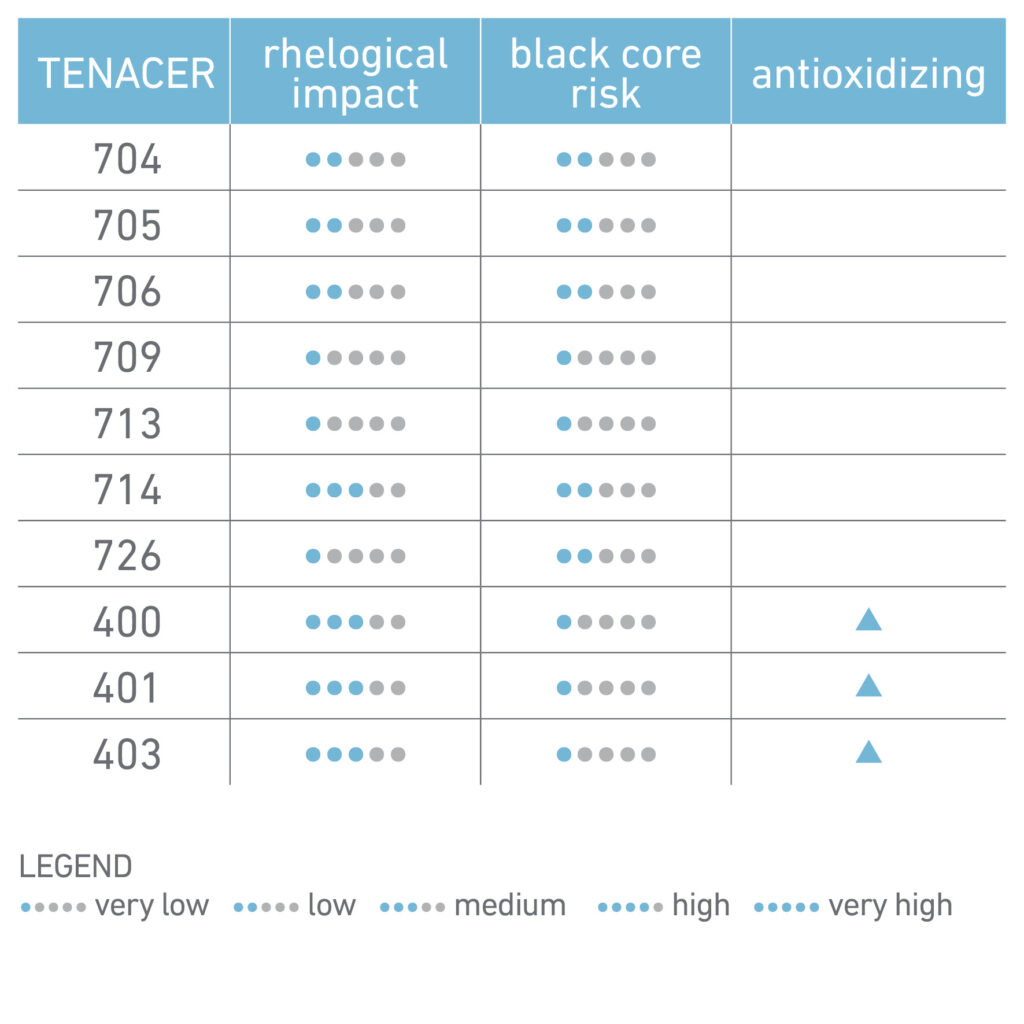
It is worth emphasizing that the TENACER range is marked by an extremely limited impact on slip rheology. This represents a defining feature of the product line: while effectively increasing mechanical strength of the dry body, TENACER binders are formulated to be introduced into the suspension without significantly altering viscosity or overall flow behavior.
In other words, the additive preserves the physic-chemical balance of the system, maintaining stability, homogeneity, and workability. As a result, storage, pumping, and spray-drying conditions can remain unchanged, allowing manufacturers to obtain the desired mechanical benefits without introducing new process constraints or requiring major formulation adjustments.
Dosage
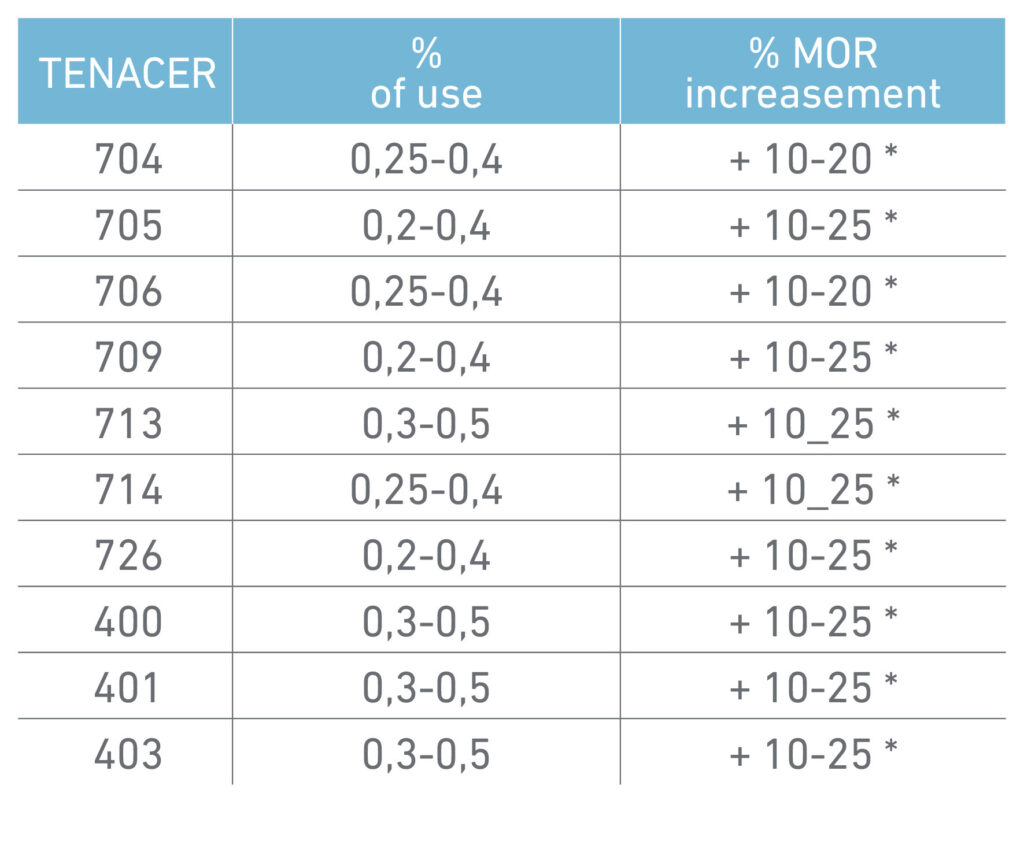
In terms of dosage, typical usage levels generally range between 0.25% and 1% on dry weight, depending on body composition and the intended application. Standard use typically falls between 0.25% and 0.5%, while 1% is reserved for specific cases. In super-white bodies with a high proportion of non-plastic raw materials, where natural plasticity is limited, binder demand tends to increase. For thicker tiles, however, attention shifts toward balancing improvements in modulus of rupture with the potential risk of black core formation. There are no binders designed exclusively for a specific thickness: rather, the dosage level itself modulates the system’s response.
Below is the summary table with all dosages