#56 Temporary binders: applications & role



- Definition
- Spray-dried powder and water content
- Slip, additivation phase and rheological impact
- Elasticity and breaking point
1. Definition
Temporary binders are additives composed of molecules, organic polymers, or inorganic components capable of acting as binding agents for the raw materials in ceramic bodies (such as sands, feldspars, clays, etc.).
These are blends whose components generate chemical interactions between particles, facilitating the pressing phase and enhancing the flexural strength of the ceramic body. As a result, once pressed, the tiles are more flexible and better able to withstand vibrations and movements along the production line.
From a chemical perspective, the binder contains functional groups—molecular segments that can chemically interact with other materials—which promote cohesive bonding between clay micelles and hard inorganic raw materials. Put simply, the additive links the inorganic particles together, forming a cross-linking net that increases the mechanical strength of the piece after drying.
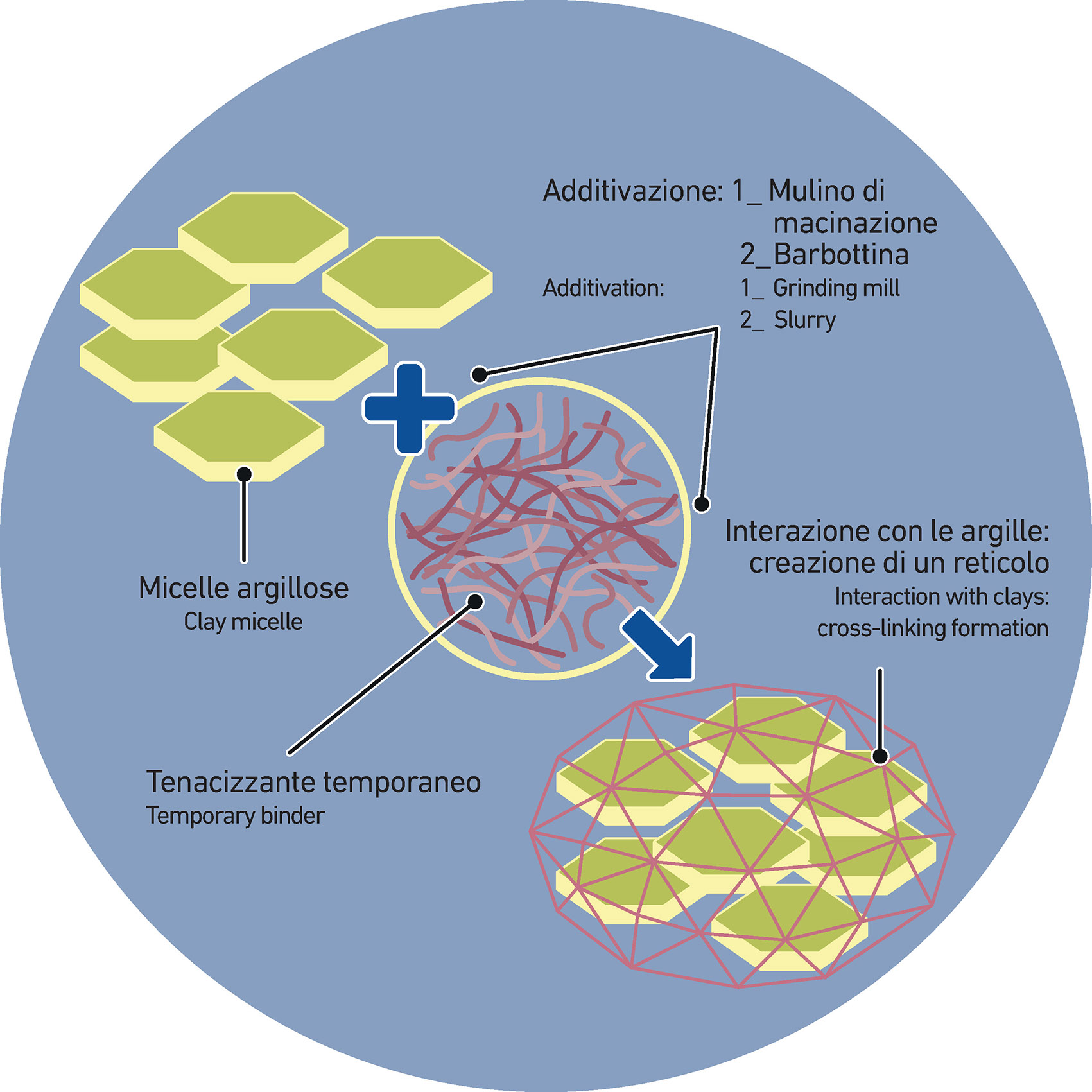
To better and more intuitively understand the power of a temporary binder, we can borrow an example from the world of cooking. While it may seem simplistic, it effectively conveys the core concept.
Let’s imagine we’re preparing cookies and working with raw dough. As we all know, this dough is quite fragile: if we try to move it, it’s likely to tear or become misshapen. Now, suppose we could add something to the dough to make it more resilient—less crumbly and more resistant—without altering the result after baking. The production process would undoubtedly benefit from greater stability and fewer risks of failure. That’s exactly the role a temporary binder plays in the case of unfired ceramic tiles.
We typically refer to temporary binders because their effect is designed to act fully during the pre-firing phase, helping protect the material from potential damage. This makes them distinct from permanent binders, which, once incorporated into the body, permanently increase the mechanical strength of the tile—even after firing.
There are various types of temporary binders which, depending on their formulation, may enhance certain reactions over others. However, in general terms, two main macro-categories can be identified:
- Inorganic temporary binders: These are generally materials of mineral origin (such as clays, feldspars, carbonates, oxides, etc.) that help increase the strength of the ceramic body. In cases where the body is marked by low plasticity, for example, an inorganic temporary binder (containing minimal amounts of clay) can be particularly effective. These are typically powder-based products that do not burn off during firing.
- Organic temporary binders: These include products of natural origin or derived from natural sources—such as sugars, native or modified starches, lignin derivatives, etc.—as well as synthetic resins (polymers). These raw materials are typically water-soluble or water dispersible. By their nature, these products burn off during firing, so it is important that they decompose efficiently at low temperatures to avoid defects such as black core formation.
2. Spray-dried powder and water content
The action of the temporary binder can develop along multiple paths, but typically it acts both on the individual granules of spray-dried powder and on the ceramic body as a whole.
As is well known, spray-dried granules are formed inside atomizers, where the liquid slip is nebulized under pressure and exposed to hot air flows. This process causes rapid evaporation of the water content, transforming the suspended droplets into dry, spherical granules. However, these spray-dried granules retain an internal moisture content—typically between 5% and 7%—which is essential for the proper execution of the forming phase (compaction for large slabs) or conventional pressing. A spray-dried powder with no residual moisture would be completely unmanageable during processing.
What does this mean?
This means that water plays a partially cohesive and binding role.
Imagine trying to build a sandcastle with completely dry sand—without any moisture at all. It simply wouldn’t hold together, as the grains lack the cohesion needed to maintain the shape you’re trying to create. On the other hand, too much water would be just as problematic. In that case, the sand would become overly saturated, dispersing into the liquid phase and preventing proper compaction for entirely different reasons.
With the proper distinctions in mind, a similar principle applies in ceramic production lines.
Spray-dried powder must retain a precise level of residual moisture to effectively support the forming process—whether through pressing or compaction—before the ceramic body undergoes further treatments along the glazing line. Striking the right moisture balance is crucial not only to ensure the quality and integrity of the ceramic piece, but also to safeguard equipment functionality and maintain safe, efficient working conditions.
If the spray-dried powder is too wet—meaning it contains an excessive amount of moisture—it can lead to production issues. For example, it may partially stick to the press punches, forcing production staff to stop the line to clean the equipment, which results in unwanted downtime.
Conversely, if the residual moisture is too low, the ceramic body becomes less compact and—putting it in non-technical terms—powderier and more unstable. This can cause dust to disperse throughout the working environment, settling on machines and even on already-pressed tiles. Such contamination may not only interfere with production quality but also pose a challenge for workers along the line.
This is why achieving the right moisture balance is essential. While water is crucial during the pressing and forming stages, if not properly controlled, it can cause issues later in the production cycle.
One way to manage moisture levels effectively is using appropriate temporary binders. These additives enhance the adhesive strength between granules, making it possible to reduce the overall water content in the formulation. This is especially important for manufacturers, as working with high-density slips—which require less water—leads to lower production costs. The primary savings come from reduced energy consumption during the evaporation phases that take place both in spray dryers and in dryers.
In short, for ceramic producers, the less water used, the better.
3. Slip, additivation phase and rheological impact
The slip is the result of the wet milling process of the raw materials used in the ceramic body.
These materials are typically mixed with water and deflocculants to obtain a fluid suspension.
Once it exits the mill, the slip can follow one of two possible paths:
- Stored in underground holding tanks equipped with low intensity stirring systems, designed to prevent sedimentation and/or gelation. These issues are related to the thixotropic nature of slips, which tend to increase in viscosity when left static.
- Transferred directly to the spray dryer for the next stage of the production process.
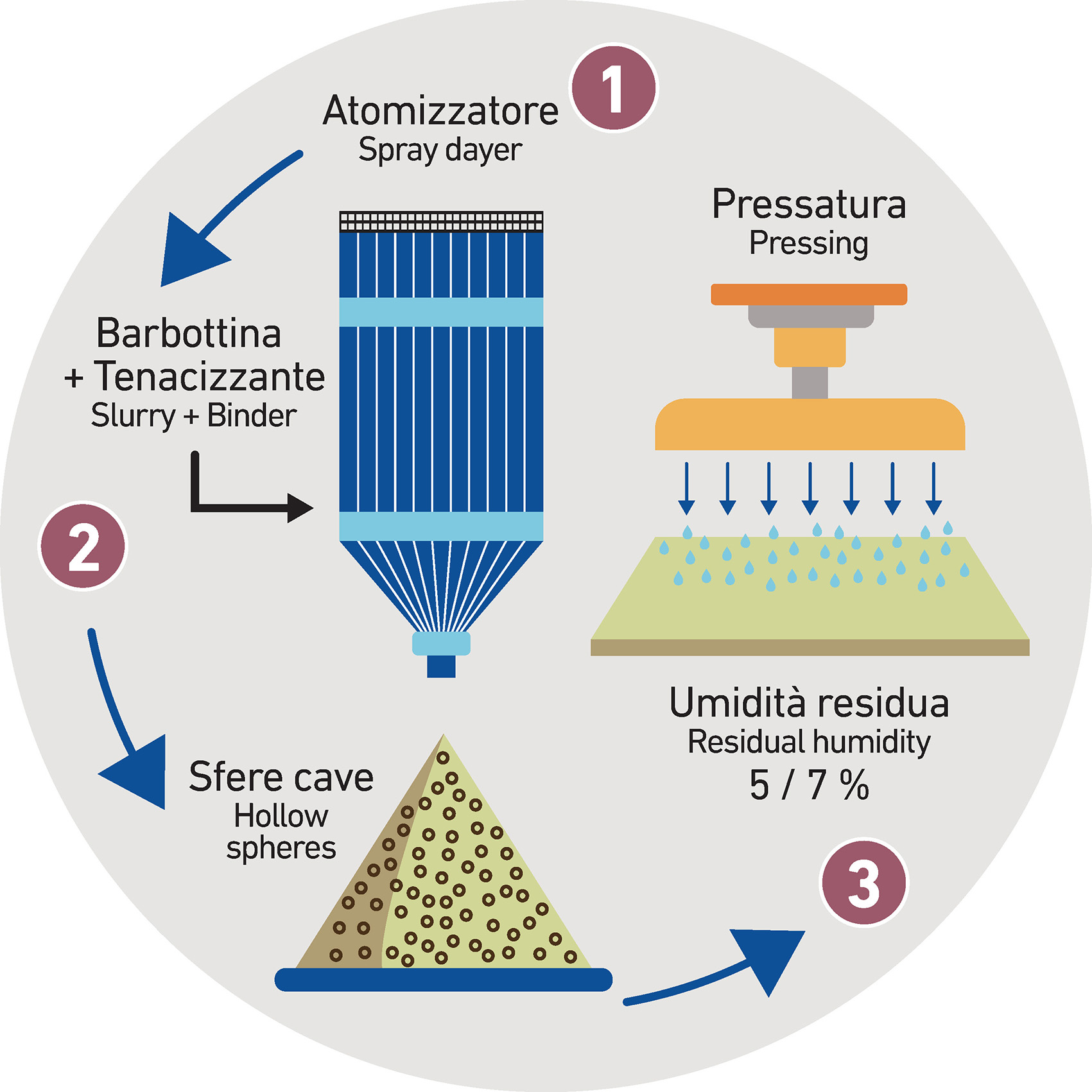
In most cases, temporary binders are added to the slip after the milling phase (and only very rarely during milling). They can be introduced either in the tank or in-line during transfer. But what does this mean?
In the first scenario, the binder is gravity-fed from above into the storage tank, where it is gently and continuously stirred to ensure proper dispersion. In the second scenario, the additive is injected through auxiliary piping connected to the main pipeline that carries the slip from the mill to the storage tank. In both cases, however, the destination of the mixture is the tank.
Regardless of how they are introduced into the process, temporary binders must always meet a fundamental requirement: they must not negatively affect the rheological properties of the suspension (in this case, the slip). In other words, they should not alter the key characteristics of the mixture to which they are added, such as viscosity or yield stress.
Any significant variation—either upward or downward—can lead to issues. A sudden increase in viscosity, for example, may cause the slip to swell and create the so-called “soufflé effect,” making it difficult to process. On the other hand, a sharp decrease in viscosity could result in unwanted sedimentation. In essence, if the slip is in a stable condition, any additive should preserve that stability rather than disrupt it.
More broadly speaking, any additive used must be characterized by non-critical behavior, meaning that the ingredients or components selected during formulation—those that will make up the final product—should not compromise stability or interfere with predefined processing parameters.
It is equally true, however, that a formulation well-suited to one production setting might produce undesirable effects in another. As always, success lies in developing a tailor-made product that meets the specific criteria and requirements defined by the customer.
4. Elasticity and breaking point
The formulation of a temporary binder must take several factors into account. However, two key aspects currently deserve particular focus:
- Elasticity
- Breaking point of the ceramic material
The first refers to a material’s ability to deform and then return to its original shape without breaking or sustaining damage. This elastic behavior can be repeated over time, but once the material reaches—or exceeds—its maximum deformation threshold, it can no longer recover its initial form. The breaking point, on the other hand, marks the moment when the material fails structurally. In ceramics, this point is typically determined through laboratory testing using a flexural strength tester (often a chrometer). Once this limit is surpassed, the ceramic piece breaks.
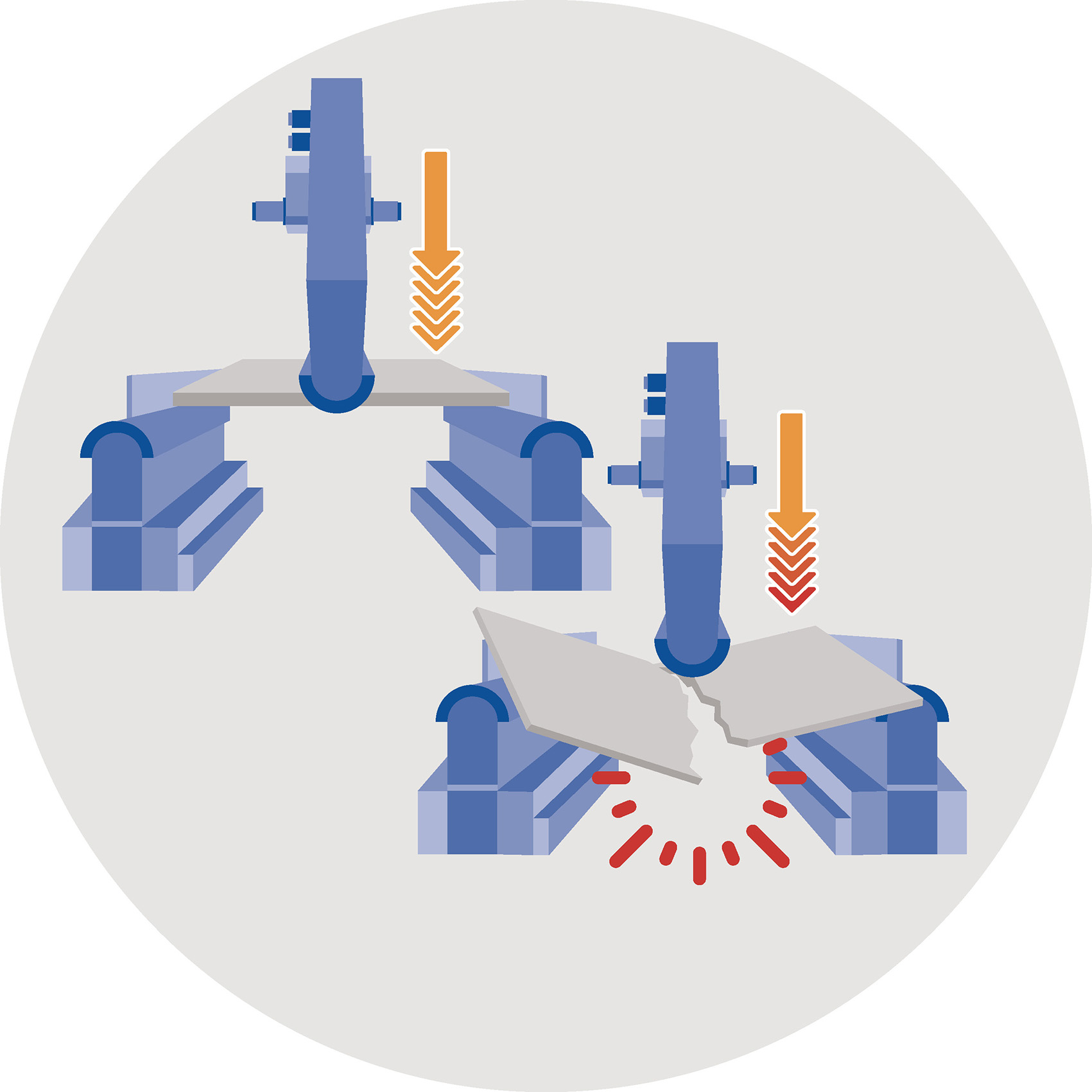
The “green body”—that is, the ceramic material after pressing/forming, still moist and not yet subjected to drying—tends to be more flexible. Given the same applied force, it will bend more than a dried tile. The dried tile, being stiffer, is less elastic and undergoes less deformation before breaking.
While it’s important to avoid rigid generalizations that often lead to oversimplification and inaccuracies, we can nonetheless state that—in absolute terms—the green body is more elastic but also more fragile and delicate (meaning it requires only a modest amount of force to reach its breaking point). By contrast, the dried material is generally less elastic but considerably stronger and more resistant to breakage.
Temporary binders can modify both the elasticity and mechanical strength—in terms of breaking point—of ceramic bodies. These properties may vary depending on the specific product and formulation.
What does it mean to modify elasticity?
It means reducing the Young’s modulus of the material—i.e., the measure that indicates how much a material tends to stretch or compress under an applied load. In practical, the presence of the additive allows the material to undergo greater deformation under the same applied force, effectively increasing or shifting the breaking point.
In other cases, the additive may leave the elasticity unchanged while increasing the force the material can withstand before failure. This could be due to improved particle bonding, which enables the structure to handle significantly greater stress without breaking.
These two examples illustrate how additives can be used to target either one of the two levers—or both simultaneously—depending on specific production needs.