#64 On black cores and degassing: analyzing a defect



SHORT-CUT EDITION
The so-called black core is a darker line that appears and that it is visible within the body of a ceramic tile. Its color can range from deep brown to black—or even lighter shades in some cases. Although it rarely affects technical performance, it can become a concern whenever swelling or internal bulging is also present.
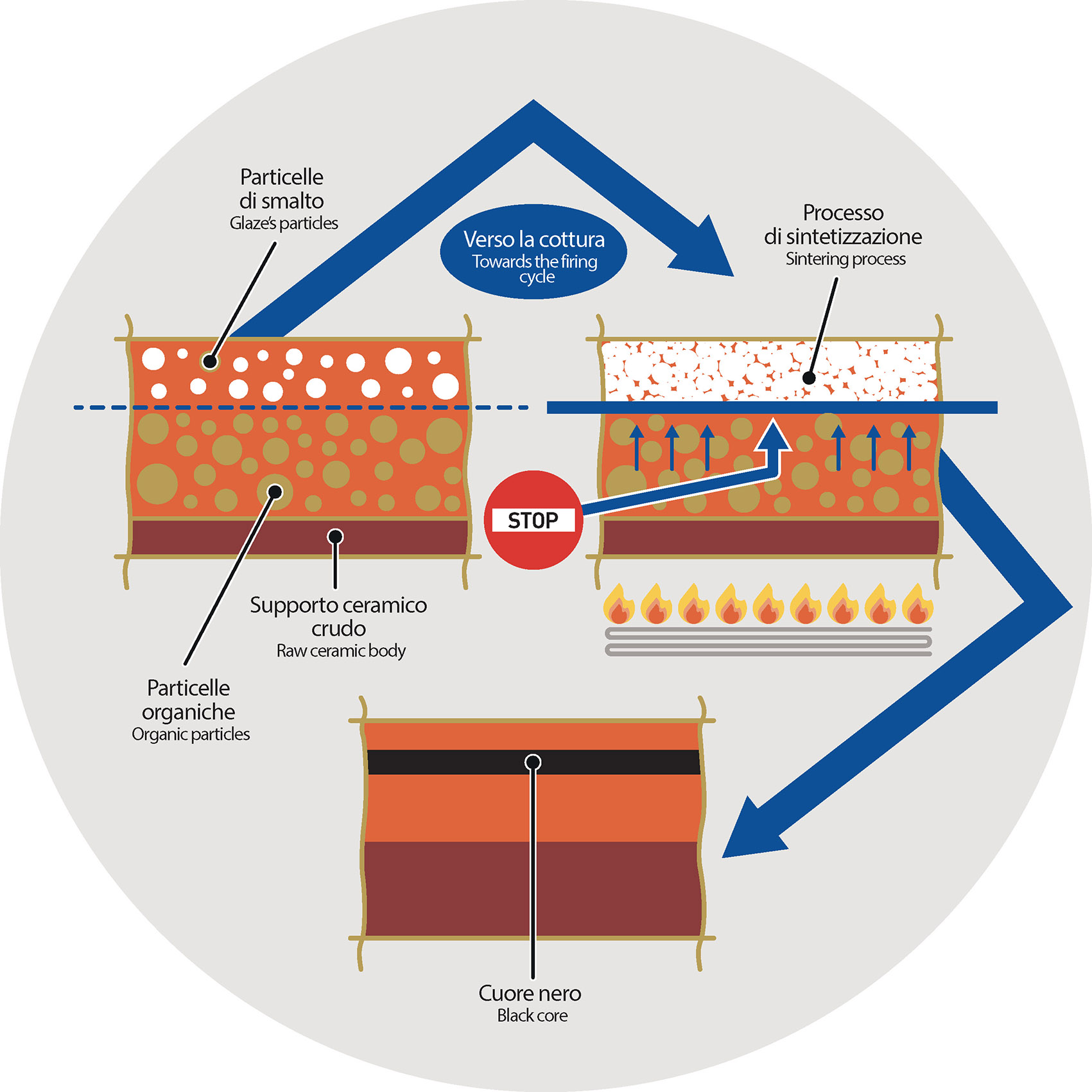
Modern raw materials usually contain very little organic residue, but today’s highly compacted bodies—designed to improve productivity and mechanical strength—tend to trap any remaining organics inside the tile during the early heating stages. When these substances cannot burn out or escape from the central area, they react differently than the outer layers, producing the characteristic discoloration shown in cross-section.
What was once a minor aesthetic issue has gained importance due to new applications of ceramics such furnishings, where edges and visible sections must be completely defect-free.
Where the problem comes from
Among the various factors contributing to the issue, the two most significant ones are outlined below.
- Incomplete removal of organic residues
In the internal region of the tile, the temperature and oxygen availability may be insufficient to oxidize and volatilize the organic materials. Fast-firing cycles—common in modern production—exacerbate this limitation. As a result, part of the organic matter remains locked inside until the sintering stage has already begun.
- Changing in the oxidation state of the pigments
In colored bodies, the issue may stem from pigments shifting to a different oxidation state in oxygen-poor environments. When the furnace atmosphere becomes reducing, pigments can transition to a lower oxidation level, altering their color mainly in the tile’s interior, where oxygen penetration is limited. This explains why the surface shows the intended shade, while the core may appear noticeably darker.
Corrective actions
The recommended actions fall into two categories: adjustments to the production line and chemical-based solutions.
Adjustment of the production line
- Slightly reducing the green-body density
Excessively compact bodies hinder gas movement. Fine-tuning the pressing parameters can improve permeability and help gases escape before sintering.
- Selecting engobes and glazes that do not melt too early
Highly fusible products may seal the surface prematurely, preventing adequate burnout of internal organics. Using materials with delayed melting behavior allows the core to degas properly.
- Modifying the firing curve
Longer or differently shaped temperature cycles give organic residues enough time to decompose and escape before the body densifies.
Chemical solutions
- Enhancing degassing
Certain additives—introduced during milling or directly into the slip—can increase the availability of oxygen within the body. These compounds promote the conversion of organic residues into simpler gaseous molecules (ideally CO or CO₂), which can migrate out of the tile during pre-sintering.
- Adjusting the oxidation state of pigments
When the black core is tied to a pigment’s redox behavior, specific additives can trigger controlled oxidation–reduction reactions inside the body. This helps align the pigment’s color response in both the interior and exterior of the tile, ensuring a more uniform final appearance.
Conclusions
Black core usually does not compromise the structural integrity of porcelain stoneware, but it can be visually unacceptable in applications where edges or thicknesses are exposed. The phenomenon is mainly driven by trapped organic residues and by pigment redox shifts in oxygen-poor regions. Effective mitigation requires a combination of process adjustments—permeability, glaze behavior, firing profile—and targeted chemical tools designed to improve degassing and stabilize pigment behavior throughout the tile’s cross-section.