#65 Rheological additives in ceramics: principles, functions, and role



Introduction
Most ceramic manufacturing processes rely on dispersing solid powders in a liquid medium—typically water—to form a suspension, or more broadly, a dispersed system. While transferring solid particles into a fluid requires careful control, it offers clear advantages from a production standpoint. Liquid-based dispersion processes are widely valued for their efficiency, yet they also present challenges that stem from the very nature of these systems.
One of the main issues is particle agglomeration, which can lead to the formation of large clusters. These may cause phase separation through sedimentation or, if they remain suspended, increase viscosity, making handling, shaping, and application more difficult. Agglomeration can also result in less densely packed solids, ultimately leading to lower-than-desired final density. Controlling particle aggregation is therefore critical, especially in casting processes where low viscosity is essential. In other operations, such as extrusion or injection molding, deliberately flocculated suspensions are preferred, as they provide the rheological behavior required by the process. In general terms, minimizing agglomeration is equivalent to improving the colloidal stability of the system.
Overall, the use of additives serves three key purposes: enhancing the efficiency of shaping and application processes, ensuring sufficient cohesion and mechanical strength in the green body, and ultimately improving the overall quality of the finished ceramic product.
Main chemical categories
No matter how complex a ceramic suspension may be, it can always be broken down into three fundamental components: solid powders, the liquid in which they are dispersed, and additives. This framework applies regardless of chemical composition, physical state, or the number of materials involved.
Additives are commonly classified according to their primary effect on the suspension. It is important to note, however, that a single additive may perform multiple functions and therefore belong to more than one category. The two most widely used groups are deflocculants and binders. Deflocculants are designed to limit particle aggregation, making the system more fluid. The reduction in viscosity often associated with these additives is a result of fewer agglomerates, rather than their direct purpose. Binders, on the other hand, promote the formation of a network structure between particles, providing elasticity and cohesion to the material.
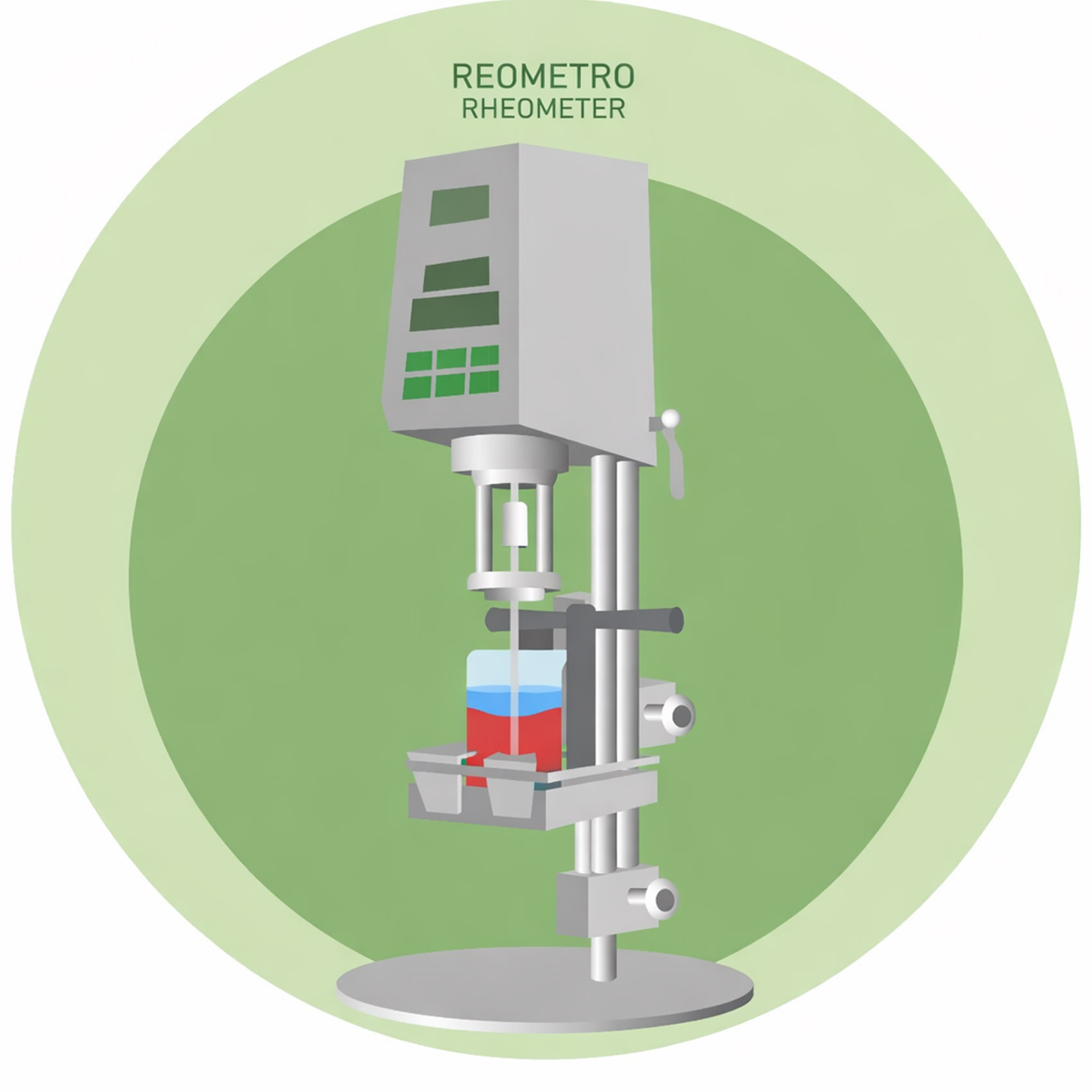
Alongside these two main categories, a wide range of additives is used to optimize process performance and the quality of the final products. These include surfactants, which improve surface wettability and facilitate powder dispersion; plasticizers, which modify viscoelastic behavior; defoaming and foaming agents, applied respectively to suppress or promote bubble formation depending on process needs; lubricants, which reduce friction against solid surfaces; and, finally, bactericides and fungicides, used to limit the biological degradation of organic components within the system.
In ceramic technical terminology, terms such as dispersant, deflocculant, and fluidizer are often used inconsistently. It is therefore useful to clarify that a dispersant simply refers to the liquid medium that hosts the solid particles, whereas a deflocculant is a substance that, when added in small amounts, reduces particle aggregation. The term fluidizer is broader and refers to any action that lowers system viscosity. However, reducing viscosity by dilution and reducing it through deflocculation are fundamentally different approaches: in the first case, the solid content is reduced, while in the second it remains unchanged and only particle interactions are modified. Although both methods lead to lower viscosity, their impact on the process and on the final product is very different. In the case of ceramic glazes, terms such as suspending agent or binder are sometimes used, which broadly correspond to the concepts of deflocculants and binders. These two families of additives are in fact the primary tools for controlling the rheology of ceramic systems and therefore deserve particular attention.
Colloidal stability and particles interactions
Ceramic processes based on the dispersion of powders in a liquid medium are known as colloidal ceramic processes, highlighting the fact that the behavior of the resulting suspensions is largely governed by interactions between colloidal particles. In these systems, suspension behavior is not determined by the entire solid fraction, but primarily by a relatively small population of very fine particles that control stability and rheological response.
Although only a portion of the particles present is small enough to significantly influence the system, this fraction plays a decisive role in viscosity, aggregation tendency, and ease of handling. When particles approach one another and form agglomerates, the system loses stability, leading to negative effects such as increased viscosity and sedimentation. For most industrial applications, it is therefore essential to achieve suspensions with sufficient stability to ensure uniform particle distribution and effective control over particle size. This makes it possible to work with materials that are easy to apply without compromising process quality.
Under real operating conditions, perfect stability is rare. More often, systems are weakly flocculated, with attractive forces that promote aggregation balanced by repulsive forces that keep particles at a controlled distance. The agglomerates formed in these cases are relatively fragile and can be readily broken up by fluid movement. This is precisely where deflocculants come into play: their role is to strengthen repulsive forces between particles and limit aggregation. This can be achieved either by increasing electrostatic repulsion or by creating a physical barrier on particle surfaces that prevents close contact. In both cases, the goal is to keep particles sufficiently separated to ensure stability, workability, and overall control of the system.
The electric double layer
When ceramic powders are dispersed in a liquid, electrical phenomena come into play in addition to the natural tendency of particles to aggregate. Solid particles interact with the surrounding medium through ionic exchanges that generate an electric charge on their surfaces. This process depends on both the characteristics of the particles and the nature of the liquid.
The presence of a surface charge causes a redistribution of ions in the solution: oppositely charged ions are attracted toward the particle surface, while ions with the same charge are pushed away. This leads to the formation of a structure consisting of the charged particle surface and a surrounding layer of liquid enriched with counter-ions. Known as the electric double layer, this arrangement ensures electrical balance within the system.
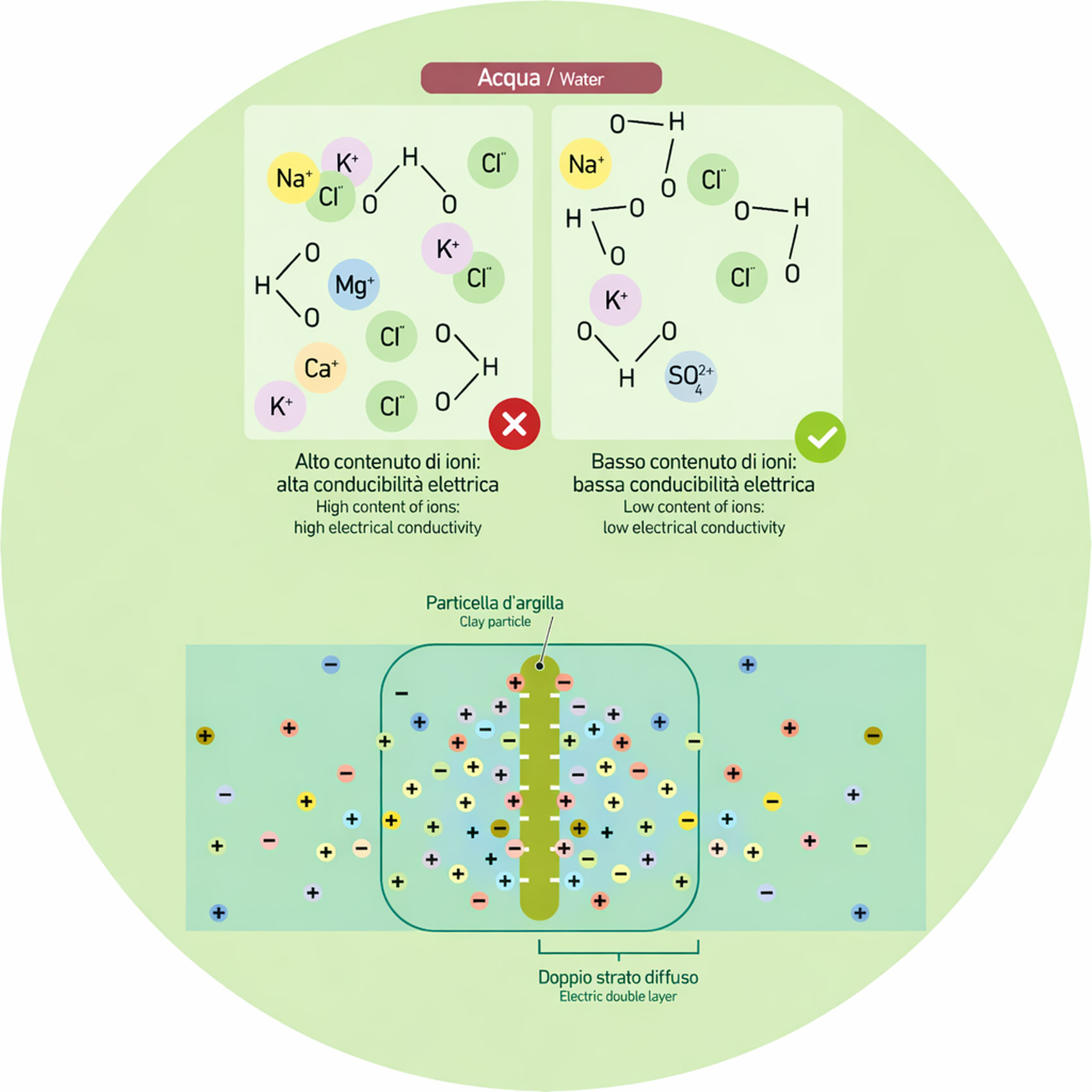
IThe electric double layer plays a crucial role in suspension stability. When particles carrying the same type of charge approach one another, interactions between their surrounding ionic layers generate repulsive forces that prevent direct contact and limit aggregation. The effectiveness of this mechanism depends on the chemical conditions of the system, particularly the ionic concentration of the liquid, which can either strengthen or weaken the stabilizing effect.
In some cases, the surface charge of particles is not uniformly distributed. This is especially true for particles with asymmetric shapes, such as clays, whose surfaces and edges exhibit different characteristics. Depending on the chemical environment—and especially on pH—these particles may carry a uniform charge or develop opposite charges in different regions. The latter situation can promote localized attractions between particles and lead to the formation of more complex structures within the suspension.
Overall, the electrical phenomena that arise during the dispersion of powders in a liquid are key factors in controlling both the stability and the rheological behavior of ceramic systems.
Electrostatic and steric stabilization
The degree of repulsion between particles in a suspension can be assessed through parameters that describe the strength of the electrical interactions involved: higher values indicate a greater ability of particles to remain separated. In real systems, however, this natural repulsion is often insufficient to counteract the attractive forces that drive aggregation, making targeted intervention necessary to improve system stability. Since reducing attractive forces is generally not feasible, the most effective approach is to enhance repulsive interactions between particles. This is achieved using deflocculants—additives specifically designed to prevent particles from coming too close to one another. These substances may act by increasing electrostatic repulsion or by creating a physical barrier on particle surfaces that prevents direct contact. In many cases, the most effective solutions combine both mechanisms.
In aqueous systems, inorganic or polymer-based deflocculants are commonly used, selected according to the characteristics of the material and the dispersing medium. Steric deflocculants offer the advantage of being less sensitive to changes in the system’s ionic composition, providing more consistent stability. A critical aspect of deflocculant use lies in selecting the right product and, above all, the correct dosage. The amount added can significantly affect the rheological behavior of the suspension: non-optimal concentrations may reduce the additive’s effectiveness or even impair system performance. Identifying the appropriate dosage is therefore a key step in achieving stable, easily processable suspensions.
Binders
In ceramic suspensions, deflocculants are often used alongside other essential additives, including binders, sometimes also referred to as flocculants. Their primary function is to create connections between solid particles, forming an internal structure that increases cohesion within the system. Binders can be introduced to meet different processing requirements. In some cases, they are used to increase suspension viscosity or modify rheological behavior, for example to reduce sedimentation during processing. In other situations, their purpose is to improve the consistency and plasticity of the green body, making it stronger and easier to handle prior to firing.
Binders used in the ceramic industry vary in nature. Some are derived from colloidal materials, both inorganic and organic, while the most common types are polymer-based. These additives act by forming a network that links multiple particles together, contributing to the structural stability of the system. Unlike deflocculants, binders are characterized by longer molecular chains, which allow them to create true “bridges” between particles. While this mechanism helps reduce particle sedimentation, it also leads to the formation of larger and more robust agglomerates, resulting in increased system viscosity. The outcome is a more structured suspension, suitable for specific applications but less fluid than a strongly deflocculated system. For electro-active binders, performance also depends on the chemical conditions of the system. Factors such as ionic concentration in the dispersing medium can influence the ability of polymer chains to extend and link particles, either promoting or limiting the formation of overly compact structures. Careful control of these conditions is therefore essential to prevent unwanted over-flocculation.
In summary, binders are a key tool for tailoring the structure and mechanical properties of ceramic suspensions and green bodies. Their use, however, requires a careful balance to ensure that processability is not compromised.
Conclusions
Controlling colloidal stability is a critical step in ceramic processes based on dispersed systems, as it directly affects rheological behavior and, in turn, the effectiveness of shaping operations. To achieve stable, easily processable suspensions, deflocculants are widely used—particularly organic ones—capable of limiting particle aggregation through combined repulsion mechanisms.
The choice of the most suitable additive depends on the characteristics of the powders and the nature of the dispersing medium, while dosage must be carefully calibrated. An insufficient amount reduces stabilization efficiency, whereas excessive addition can lead to undesirable effects, such as increased costs or renewed flocculation, resulting in higher viscosity.
In some formulations, binders are also required to provide greater elasticity and strength to the green body. However, these additives introduce additional particle interactions and tend to increase system viscosity, making careful control of physico-chemical conditions essential to maintain the right balance between stability and processability.