#55 Behind the scenes of innovation: exploring the challenges and methodology behind the development of chemical auxiliaries



- Introduction: between academic research and laboratory practice
- The hidden challenge: understanding the root of production phenomena
- The methodological maze: unraveling complexity with scientific rigor
- Navigating complexity: a scientific approach to breaking down challenges
- The path to a solution: formulation, testing, and cross-evaluations
- From lab to industry: the critical bridge of validation and scalability
1. Introduction: between academic research and laboratory practice
This paper originates from the undergraduate thesis of Giovanni Calzolari, Head of Research at Zschimmer & Schwarz Ceramco.
The aim of the following discussion is not to delve into the topic itself (in this case, the well-known issue of black core), but rather to shed light on the research methodology and the meticulous, wide-ranging work carried out daily in the laboratories of chemical companies that develop products and solutions for the ceramic manufacturing industry.
Although the starting point is an academic thesis, the actual work of laboratory technicians closely mirrors the same rigorous approach described here.

2. The hidden challenge: understanding the root of production phenomena
Today’s ceramic industry delivers materials that combine remarkable technical performance with refined aesthetics—results made possible by increasingly streamlined and sophisticated production processes. But behind the seamless flow of factory lines and the flawless appearance of finished tiles lies a web of intricate chemical and physical interactions. When issues or defects arise during production, they rarely stem from a single, isolated cause. More often, they’re the visible symptom of a deeper imbalance—just the tip of an iceberg of subtle interplays happening within the material itself. Getting to the root of such problems requires more than surface-level analysis. It calls for a deep investigation into microscopic behaviors and molecular transformations.
Take the case of the black core, for instance—that dark patch sometimes found at the center of a tile.
At first glance, it may look like a simple color flaw. In fact, it’s the result of a chain reaction: it starts with organic substances present in the body mix—either naturally occurring in the clay or added intentionally—continues with their incomplete combustion during firing due to limited oxygen flow and ends with the creation of a localized reducing environment that shifts the oxidation state of elements like iron.
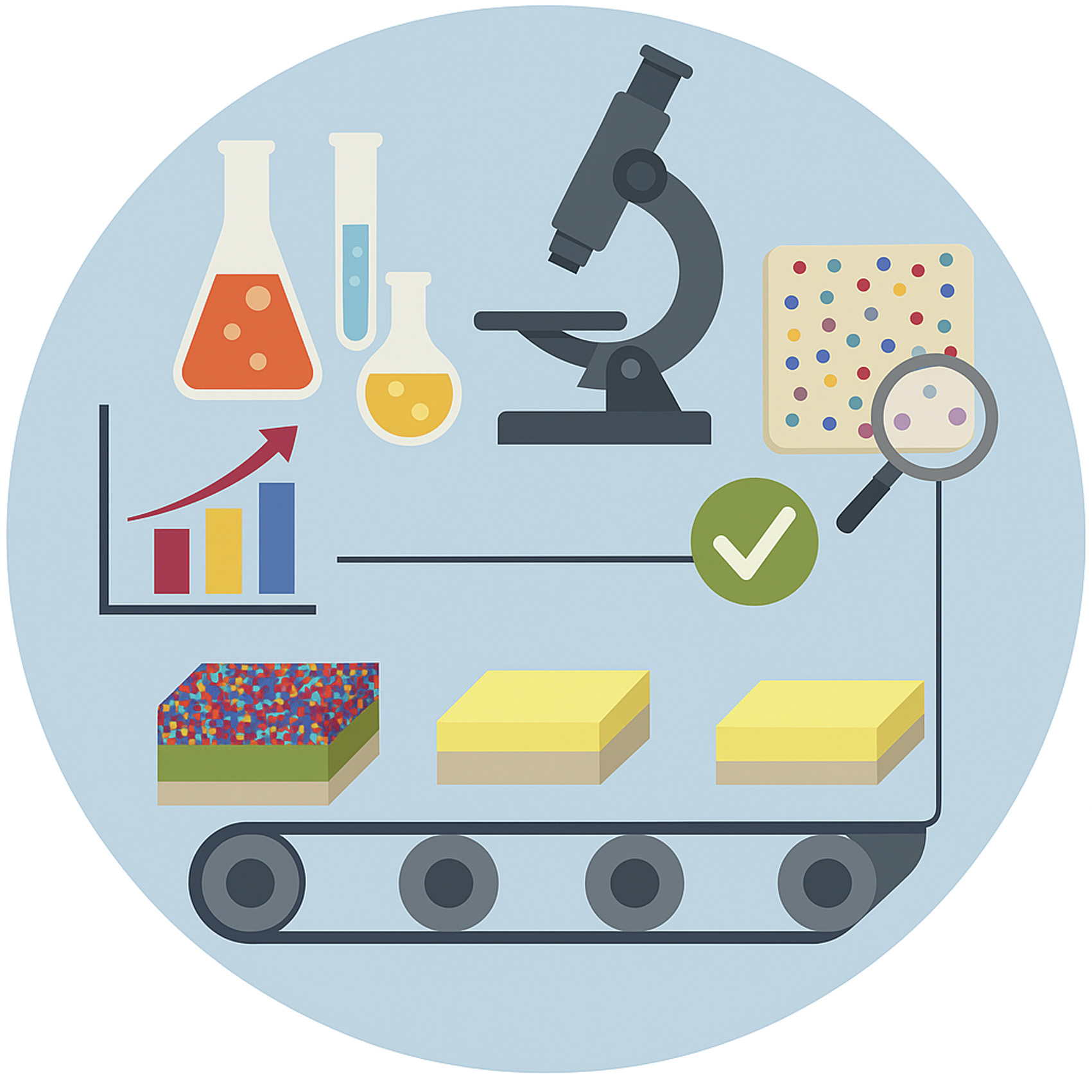
Even a quick overview hints at the layered complexity behind the issue: organic chemistry (combustion processes), inorganic chemistry (iron redox reactions), physics (the diffusion of gases—oxygen and combustion byproducts—through a dynamic porous structure), and process engineering (temperature profiles, kiln atmosphere control).
Dealing with a challenge like black core—or any similarly complex defect in ceramic production—means engaging in a true investigative process. It’s not enough to detect the flaw; what matters is uncovering the mechanisms that drive it, mapping out all the variables involved, and understanding how each one contributes to the outcome.
This kind of scientific detective work forms the foundation for solutions that are genuinely effective and precisely targeted—not just cosmetic fixes that hide the problem, but interventions that resolve it at its source. It’s a task that demands a blend of disciplines, sophisticated analytical tools, and above all, a rigorous, methodical mindset.
3. The methodological maze: unraveling complexity with scientific rigor
Once a complex production issue—such as black core formation—has been identified, the most intricate and critical phase begins: defining and applying a sound investigative methodology.
The goal is to break the problem down into its fundamental components, analyze each element both in isolation and in relation to the others, and ultimately reconstruct a complete and reliable understanding of the phenomenon.
The starting point is always a thorough characterization of the raw materials. In the case of the black core study, for instance, the base industrial body (spray-dried powder) undergoes a detailed analysis to determine:
- Elemental chemical composition (via XRF – X-ray Fluorescence), to identify the oxides present and quantify their proportions
- Mineralogical composition (via XRD – X-ray Diffraction), to determine the crystalline phases that make up the body and influence its firing behavior (e.g., quartz, feldspars, clay minerals)
- Particle size distribution (via laser granulometry), a key parameter affecting green body compaction during pressing and its permeability before firing
- Thermal behavior (via TG-DTA – Thermogravimetric and Differential Thermal Analysis), essential for tracking water loss, combustion of organics, and phase transformations during heating
- Initial content of reducing substances, to establish the starting redox potential of the body
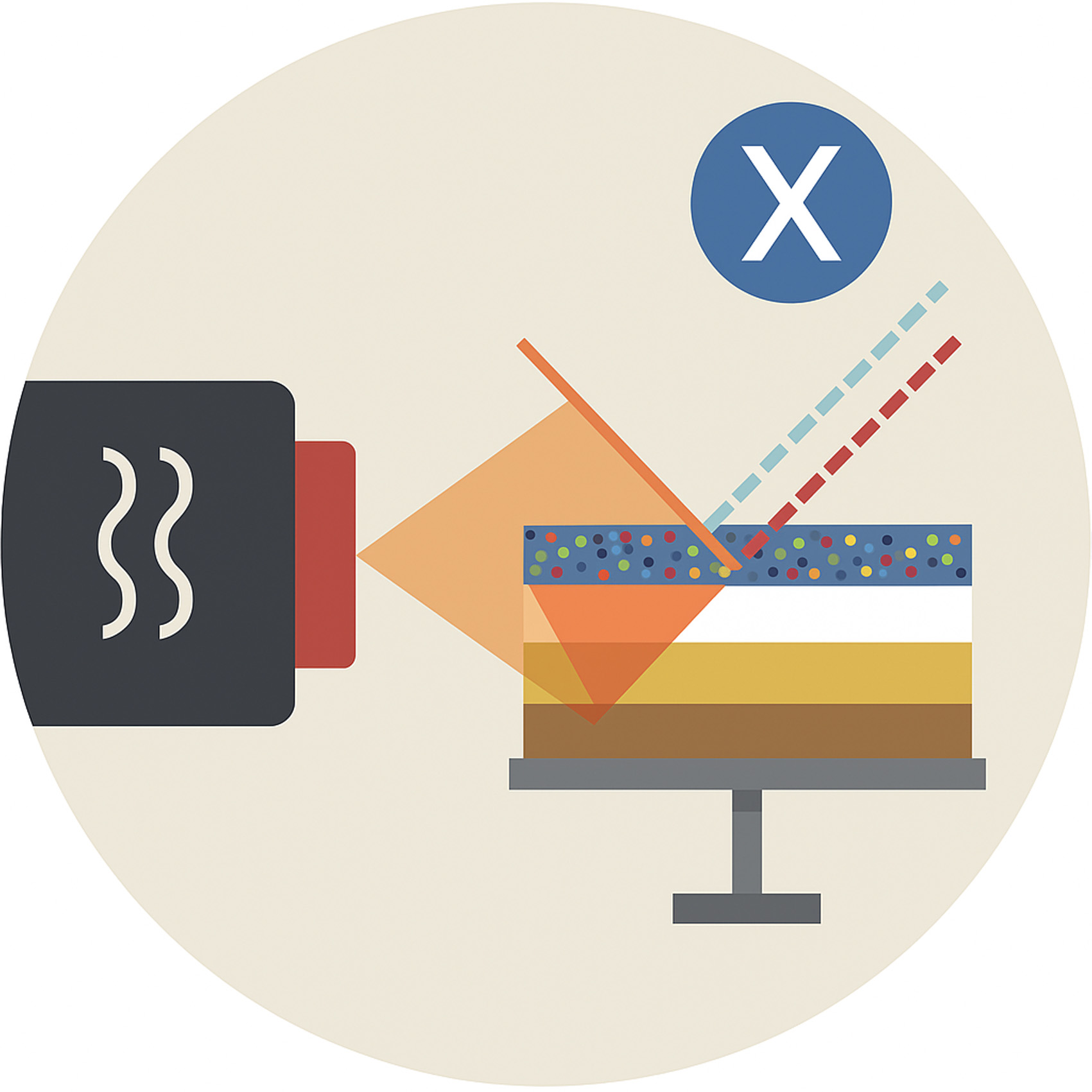
This initial characterization serves as the material’s “identity card,” but it’s only the starting point.
The next step is to simulate the production process under controlled laboratory conditions, introducing targeted variations to isolate the influence of specific parameters or components.
This involves:
- Standardized sample preparation
- Shaping of test specimens using laboratory presses which, despite their limitations, allow for control over key parameters such as pressure and thickness
- Characterization of unfired samples, measuring key physical properties like density and permeability—both of which are directly linked to how easily gases can move through the body during firing
- Controlled addition of additives, introducing known quantities of specific organic substances or potential anti–black core agents to evaluate their direct impact
- Firing under reproducible conditions, as consistent as possible
Finally, the fired samples must undergo a new round of in-depth analysis to assess the outcome of the experiment:
- Physical measurements, such as water absorption (an indicator of the degree of sintering) and residual permeability
- Compositional and morphological analyses, including XRF and XRD to detect possible phase changes, and SEM (Scanning Electron Microscopy) to examine the microstructure
- Spectroscopic analyses, such as Raman and FTIR, particularly useful for identifying specific phases present in the black core region (e.g., magnetite) versus those in the outer zones (e.g., hematite)
- Defect quantification, using image analysis to measure the extent of the black core
This intricate combination of characterization and experimentation—requiring the coordinated use of multiple analytical techniques and meticulous planning—is standard practice in the development of chemical products and solutions for the ceramic industry. The need to thoroughly understand phenomena across multiple scales—from atomic composition to microstructure to macroscopic behavior—and to isolate the variables at play makes the entire process inherently complex and labor-intensive.
4. Navigating complexity: a scientific approach to breaking down challenges
One of the toughest challenges in developing solutions through experimental research—such as efforts to understand and address black core formation—is navigating the sheer number of variables at play and making sense of data in an environment where variability is inevitable.
Even in the controlled setting of a lab, achieving fully reproducible results is rarely straightforward.
It demands not only strict methodology, but also a sharp awareness of where errors and inconsistencies can creep in. This intense focus on detail and the drive to standardize every step are hallmarks of the complexity behind R&D work. It’s not enough to run experiments—you need to control, or at the very least account for, the sources of variation to draw conclusions you can trust.
That kind of disciplined approach to data is what makes it possible to make confident, evidence-based decisions during development. It prevents you from backing unproven solutions based on misleading results—or rejecting promising ones just because the early data is noisy. In this way, managing uncertainty and variability isn’t a side task—it’s a core part of the work of industrial chemical innovation.
5. The path to a solution: formulation, testing, and cross-evaluations
Developing a new chemical solution—such as an anti–black core additive—is rarely a straight path from concept to application. Instead, it’s more accurately described as an iterative process: a continuous cycle of hypothesis, formulation, testing, evaluation, and refinement, where each step generates insights that shape the next. This cyclical, multi-layered nature adds yet another level of complexity to the work of Research and Development.
The black core study offers a clear example of this approach:
- Targeted raw material selection, based on a clear understanding of the defect mechanism
- Initial formulation and screening: selected raw materials were added in varying amounts to known defect-prone body recipes under controlled lab conditions. Test pieces were produced and fired using standardized kiln cycles
- Monitoring potential side effects (Rheology): in parallel with firing tests, special attention was paid to the additives’ impact on the rheological behavior of body slurries. This is a key requirement for industrial use, especially when additives are introduced during milling—they must not compromise suspension workability
- Shortlisting and testing under semi-industrial conditions: candidates showing promising performance and acceptable rheological profiles were selected for further validation in more realistic process scenarios
- Final validation (Next development cycle): trials under representative conditions confirmed the effectiveness of the selected additives

The development cycle—built on hypothesis, validation, compatibility testing, and continuous refinement—reflects the inherent complexity of innovation in the chemical-ceramic industry.
Success depends on the ability to synthesize insights from multiple disciplines, interpret data that may point in different directions, and make decisions that weigh performance, process constraints, and end-use requirements in equal measure.
This isn’t just a search for the “right formula”—it’s about engineering a solution that’s technically sound, industrially viable, and fully integrated into the customer’s manufacturing ecosystem.
6. From lab to industry: the critical bridge of validation and scalability
The final—and often most demanding—stage in developing a chemical solution for the ceramic industry is the transition from lab-scale research to full-scale industrial implementation.
This step, commonly referred to as scale-up, marks a critical juncture where the success or failure of even the most promising innovations can hinge on their ability to perform under real-world conditions.
The black core case study illustrates just how complex and fragile this transition can be.
What emerged from this work was a clear takeaway: when it comes to validating anti–black core additives, laboratory testing alone isn’t enough. Effectiveness must ultimately be confirmed using tools and conditions that closely reflect those of industrial production.
This reinforces a fundamental truth in product development for industry: the lab is vital for understanding mechanisms, generating ideas, and conducting early-stage screening—but it cannot substitute for real-world validation or pilot-scale trials. Bridging the gap between controlled testing and plant-floor reality requires dedicated expertise, specialized equipment, and close collaboration with ceramic manufacturers to test under representative conditions.
In short, bringing a chemical innovation from concept to industrial application is a long, complex, and resource-intensive journey. It calls for deep scientific understanding of the phenomena involved, a rigorous methodology to manage variables and uncertainty, an iterative development process that balances performance, compatibility, and cost—and finally, the critical ability to validate solutions at an industry-relevant scale.
This intricate blend of science, engineering, and industrial pragmatism is what enables suppliers of chemical auxiliaries to develop the often “invisible,” yet essential, solutions that keep ceramic production flowing efficiently and make it possible to manufacture ever more advanced materials.