#54 Top glaze: what is it & how to apply it



- Characteristics and features of top glaze
- Formulation of top glaze & chemicals
- Application methods:
- Airless applications
1. Characteristics and features of top glaze
In the ceramic field, “top glaze” refers to the glaze applied as the final layer onto the still-unfired ceramic substrate, after the tile has successively received all aqueous suspensions on the glazing line and the materials discharged by the digital printer (such as glue, ink, etc.). It is, therefore, the outermost layer of the ceramic product—the one we typically walk on or touch.
The application of a final glaze layer before the product enters the firing cycle is now a standard practice in most of the ceramic production. There are very few cases where this step is not required, whether for technical or aesthetic-technical reasons. The top glaze can serve multiple purposes, but broadly speaking, it is mainly intended to both protect the underlying decoration and provide the surface with specific technical and aesthetic features.
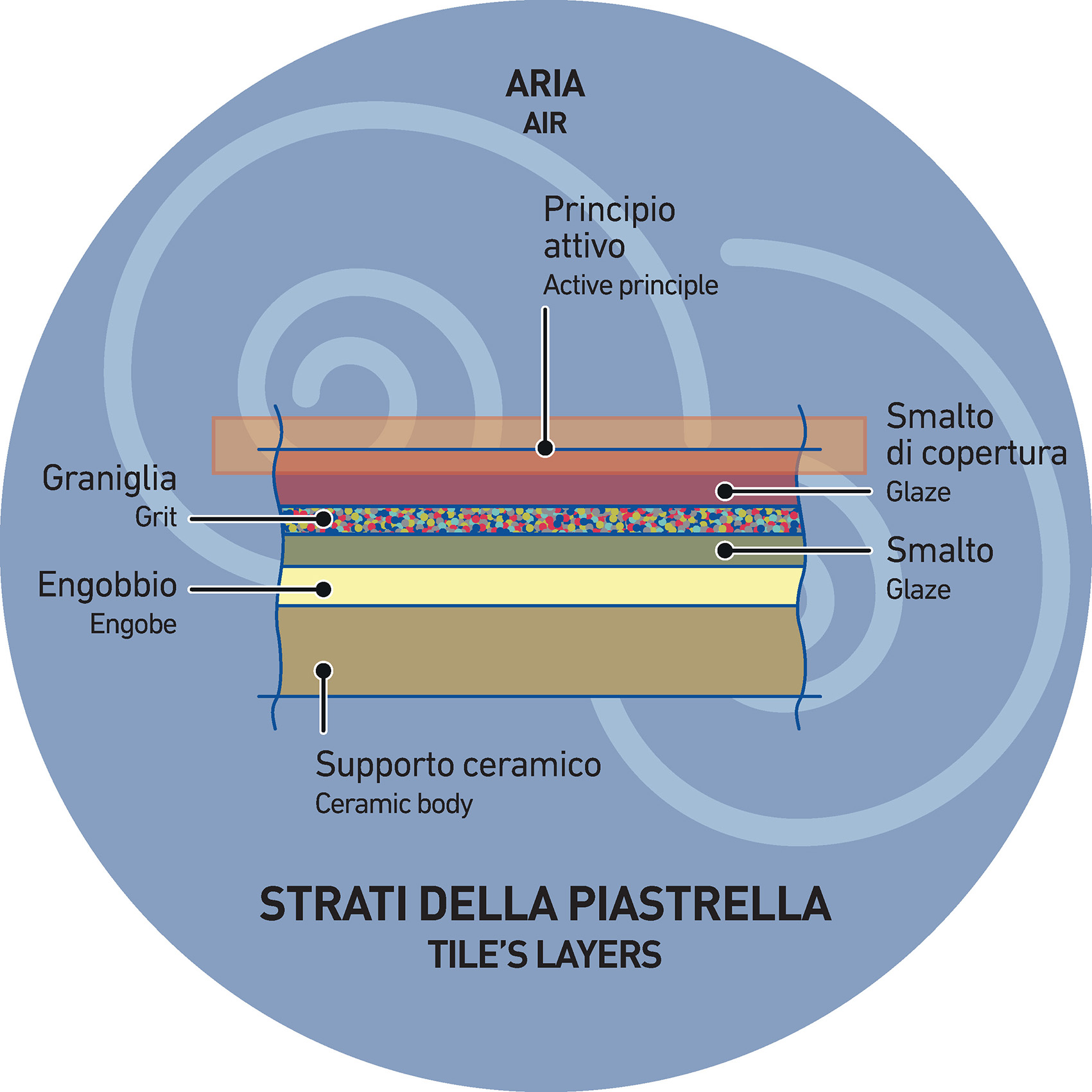
What characteristics are we referring to?
Among the most important: surface mechanical strength, resistance to cleaning agents, stain resistance, and overall chemical durability.
The top glaze also plays a key role in determining the slip resistance and wear resistance of the surface—critical aspects in defining a tile’s intended application. For instance, flooring designed for high-traffic environments—such as airports, public spaces, or train stations—requires very different performance features compared to tiles used as indoor wall coverings in residential spaces.
Depending on the level of stress expected in use, different top glazes must be selected to ensure the product performs appropriately.
Aesthetically, the top glaze defines the surface finish, such as gloss or matte appearance, and contributes to the perceived depth of the material.
In short, the top glaze is central to shaping the technical and visual identity of the final product.
We could even say that the surface’s physical and chemical properties of a ceramic tile are largely determined by the features imparted by the top glaze.
2. Formulation of top glaze & chemicals
Who defines the properties of the glaze?
Glaze formulation is typically handled by specialists working in the R&D laboratories of ceramic manufacturers, raw material suppliers, or color companies. These labs are responsible for developing glaze compositions that meet the desired aesthetic and technical requirements, while also being compatible with the specific production processes of each individual company.
Since these glazes form the outermost layer of the tile, they must ensure that the final surface is non-porous, uniform, and sufficiently transparent, to both enhance and protect the decoration beneath.
To achieve these results, glaze formulations generally contain lower amounts of plastic raw materials in the solid component compared to those used in engobes or ceramic bodies. This helps to ensure the required surface quality without compromising the performance during firing.
PLASTICITY
In physics and materials science, plasticity—or plastic behavior—is the ability of a solid to undergo significant, irreversible changes in shape when subjected to applied forces.
In certain metals, low levels of applied stress can produce an elastic response: as the load increases, deformation increases proportionally, and once the load is removed, the material returns to its original shape. However, when the applied stress exceeds a certain threshold—known as the yield strength—deformation increases more noticeably, and once the load is released, part of the deformation remains. This marks the onset of plastic behavior.
In the context of ceramics, the plasticity of the ceramic body is a highly sensitive parameter that can have a strong impact—either positive or negative—on several production stages. It is especially crucial during pressing or shaping, where the ceramic support is formed. The required degree of plasticity varies depending on the specific type of product being manufactured and must be carefully adjusted.
The plasticity of a ceramic body is closely linked to the nature of its raw materials—particularly the clay minerals, which are considered “plastic” components due to their dominant role in defining this property.
When it comes to the formulation of a top glaze, the use of clay-based raw materials is typically minimized. This is because clays tend to soften at higher temperatures than other common glaze ingredients (such as frits or fluxing agents). Moreover, their high refractory oxide content can lead to undesirable opacification of the glaze—an effect that is often best avoided.
Whether intended for a top glaze application or not, the varying nature of glazes—and particularly the differences in their solid-phase composition—inevitably requires the use of additives with diverse functional properties.
By acting on and adjusting the internal parameters of the suspension according to the desired outcome, additives must impart specific behaviors that depend not only on the suspension itself, but also on a broader set of factors: the line setup, the chosen application system (e.g., airless, waterfall, disk, bell, digital, etc.), and process conditions such as line speed or tile surface temperature. In other words, the selection of the additive is not solely dictated by the glaze formulation.
Broadly speaking, the solid composition of the suspension strongly influences the type and dosage of additive to be used—especially when it comes to dispersants and binders.
For example, different types of dispersants (with distinct chemical compositions) may perform efficiently depending on the specific glaze formulation in use.
3. Application methods
As previously mentioned, the choice of application method directly influences the selection and dosage of additives—both in terms of quantity and type—to ensure that the suspension acquires the appropriate and specific properties required for the selected application system.
- AIRLESS APPLICATIONS
The airless spray booth, complete with its components (nozzles, needles, etc.), is known for its versatility. Depending on how it’s configured, it can handle glaze suspensions across a wide density range. This means it can be adapted to suit various product types—whether that calls for a light top glaze or a much heavier application.
This wide operational flexibility also implies that airless-applied top glazes can lead to different outcomes once fired. For example, a glaze applied at higher density might be suitable for post-firing processes like polishing or lapping, whereas lower-density applications are generally not ideal for such treatments.
Of course, rheology must always be carefully engineered in the lab—tested, adjusted, and fine-tuned to achieve the best result for the specific production setup.
Additionally, as is well known, airless systems work by atomizing the glaze, breaking it down into very fine droplets. In cases where the suspension is particularly viscous and dense, certain challenges can arise. Let’s explore that scenario step by step.
- The glaze suspension passes through a nozzle that atomizes it
- The micro-droplets of glaze fall and deposit onto the ceramic substrate
- In most cases, the droplets dry relatively quickly
- When working with high-density systems (highly viscous, with high solids content and low water content), there’s a risk that the glaze layer may apply unevenly—producing an irregular, poorly leveled, and non-uniform surface—due to excessively fast drying times.
To address the issues that may arise with this type of application, several strategies can be adopted.
From the standpoint of additives, surfactants play a key role in influencing how the glaze is atomized.
By reducing the surface tension of the glaze, surfactants promote two main effects.
On one hand, they reduce droplet size during spraying, allowing the glaze to be atomized more efficiently and without major issues. On the other, lower surface tension improves the glaze’s ability to wet the ceramic body, resulting in a more uniform and even spread, which in turn enhances the final aesthetic and technical outcome.
That said, it’s important to underline that surfactants come in many types, each with distinct behaviors and benefits. For this reason, preliminary lab testing is always essential to determine the most suitable surfactant for a given formulation and process.
To improve glaze leveling, other types of additives may also be used—such as binders and/or dispersants—to adjust drying time according to production needs. These can be calibrated to either slow down or accelerate the evaporation rate of water.
The mechanism through which drying time is extended or shortened depends on both the quantity and type of additives used. As a rule, glazes with higher binder content tend to dry more slowly, since these materials naturally retain more water.
In most cases, binders, dispersants, and surfactants work together, and performance depends on finding the right balance between them.
For example, the use of a dispersant typically lowers the viscosity of the glaze suspension, which means less energy is needed to achieve proper leveling. In such cases, a surfactant with lower wetting power may be more appropriate to avoid overcompensation.
Overall, it can be said that to ensure proper application via airless systems, a glaze should generally exhibit moderately low viscosity. The higher the viscosity, the greater the risk of application defects.
- DIGITAL APPLICATIONS (DROP ON DEMAND)
Top glaze applications using drop-on-demand (DOD) systems present specific challenges that differ significantly from those encountered with other application methods.
The DOD printing technology, which relies on the precise deposition of glaze droplets, requires carefully monitored and finely tuned rheology to ensure process reliability.
Among the most critical issues to avoid is sedimentation within the aqueous system—a problem of utmost importance.
Unlike airless systems, which by their nature can sometimes handle glazes with only moderate stability and a tendency to settle, digital systems are far less forgiving. They demand a narrower operational window in terms of rheological behavior. Even a single nozzle becoming clogged due to sedimentation can lead to a complete halt of the production process.
In this context, the inclusion of adequate suspending additives becomes essential. Both the suspending power and dosage must be precisely defined based on the specific parameters and conditions of the production line.
More broadly, digital application methods are inherently more complex and depend on more delicate operational balances, making the role of additives significantly more impactful. Rheological performance must be tightly controlled—otherwise, a variety of defects can arise.
One of the most common of these is the well-known “gridding” effect, a defect unique to this type of application, which can sometimes remain visible even after firing.
Gridding typically results from a combination of inadequate glaze rheology and excessively fast drying, though it can stem from multiple interacting factors.